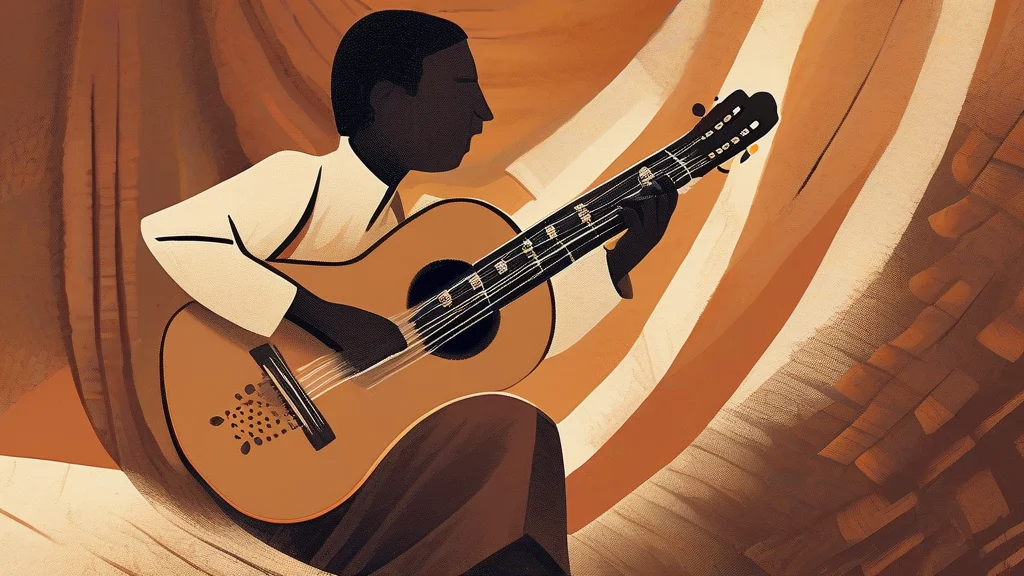
What does charango mean?
The charango is a small stringed musical instrument originating in the Andes, where it remains central to the folk traditions of Bolivia, Peru, northern Chile, and Argentina. Compact enough to be held close to the chest like a ukulele, it usually has five pairs of strings — ten in all — tuned so that the middle course sounds highest. Its earliest bodies were famously made from the shells of armadillos, though wood is now the standard material. Bright, penetrating, and slightly nasal in tone, the charango carries melodies in Andean ensembles alongside instruments such as the quena flute and bombo drum. In English, the word functions simply as a noun naming the instrument, appearing most often in discussions of world music, travel writing, and ethnomusicology. For learners of vocabulary, it offers a vivid example of how cultural artifacts travel into English along with their native names.
nounA small five-stringed (or ten-stringed, in courses of two) Andean lute, traditionally made from an armadillo shell or carved wood, played widely in Bolivia, Peru, and Argentina.
- The small Andean lute with five or ten strings in courses, typically with a body traditionally fashioned from an armadillo shell.
"She accompanied the folk song on a charango she had bought in La Paz."
"He strummed the charango gently as the dancers circled."
"The band's sound blends electric guitar with the bright, chiming voice of the charango."
The anglicized plural 'charangos' is standard in English; the invariant form 'charango' also appears, especially in writing about Latin American music.
"The shop sold handcrafted charangos made from local hardwoods."
The first charangos were made from armadillo shells — the animal's back literally became the instrument's soundboard.
Reviewed by Deb Chak, Editor. AI-assisted content curated by RJS Tech Solutions LLP.
Etymology of charango
The word charango comes from Spanish, which adopted it during the colonial period in South America; its deeper etymological roots are uncertain. It names an instrument that developed in the Andean highlands after Spanish colonists introduced small stringed instruments such as the vihuela and baroque guitar in the sixteenth century, which indigenous musicians adapted into a smaller local form. Related terms include charanguista, denoting a charango player, and charanguito, a smaller variant of the instrument.
How charango is actually used
Borrowed directly from Spanish and used in English without italics in most modern writing. The word refers to the instrument itself rather than to music played on it. Plural forms vary: both 'charangos' (anglicized) and unchanged 'charango' are encountered, with 'charangos' more common in general English prose.
Easily confused with charango
Charcoal is a black carbon fuel; a charango is a small Andean stringed instrument.