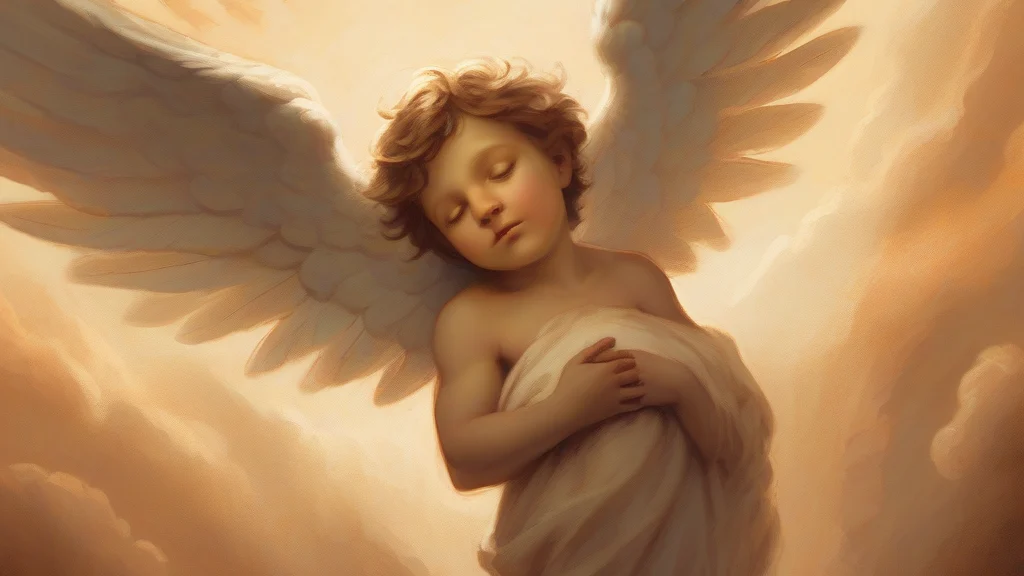
What does cherub mean?
A cherub is, at its root, a kind of angel described in the Hebrew Bible as a formidable winged being charged with sacred duties — most famously guarding the Garden of Eden with a flaming sword and overshadowing the Ark of the Covenant. Over centuries, however, the word's meaning softened dramatically. Through Renaissance art, which drew on the classical putto, the cherub became the plump, rosy-cheeked child with tiny wings familiar from countless paintings and valentine cards. Today most people encounter the word in this affectionate sense, using it to describe any especially sweet or innocent-looking baby or small child, as in 'she has the face of a cherub.' The plural is 'cherubs,' while 'cherubim' survives mainly in religious and scholarly writing. The adjective 'cherubic' describes someone with a soft, round, angelically innocent face. Few words have traveled so far — from terrifying divine sentinel to symbol of cuddly innocence.
One of an order of winged angelic beings in the Bible who serve as guardians and attendants of God.
"Two golden cherubim spread their wings over the Ark of the Covenant in the Tabernacle."
The traditional biblical plural is 'cherubim'; the anglicized 'cherubs' is also widely accepted.
A plump, rosy-cheeked child depicted in art, or figuratively, any beautiful innocent child.
"Every aunt at the christening remarked on what a perfect little cherub he was."
This sense takes the regular plural 'cherubs'.
Both plurals are standard. 'Cherubim' is preferred in religious, liturgical, and scholarly contexts referring to the biblical beings; 'cherubs' is the natural choice for everyday use, including the sense of a cute child.
"Renaissance painters filled their canvases with winged cherubs floating on clouds."
The rosy-cheeked babies we call cherubs are nothing like the original biblical ones — real cherubim were awe-inspiring, multi-winged guardian creatures stationed at the gates of Eden.
Reviewed by Deb Chak, Editor. AI-assisted content curated by RJS Tech Solutions LLP.
Etymology of cherub
Cherub comes from the Hebrew 'kheruv', a term for a winged celestial guardian that appears throughout the Hebrew Bible. The word passed into English through Latin 'cherub' and Greek 'cheroub', arriving in Old and Middle English in religious texts. It shares its ancient Near Eastern biblical heritage with other Hebrew loanwords such as 'seraph', 'behemoth', and 'leviathan'. The modern association with chubby infants arose during the Italian Renaissance, when artists merged the biblical cherub with the classical putto.
Related word forms
How cherub is actually used
In religious and scholarly contexts, 'cherub' retains its biblical sense of a powerful celestial guardian, with the plural 'cherubim' preferred. In everyday speech and art criticism, it almost always means a chubby, angelic-looking child, taking the regular plural 'cherubs'. The word carries affectionate, tender connotations in modern use.
Easily confused with cherub
A seraph is a different order of angel in biblical tradition, associated with burning and standing near God's throne, whereas a cherub was originally a guardian figure.