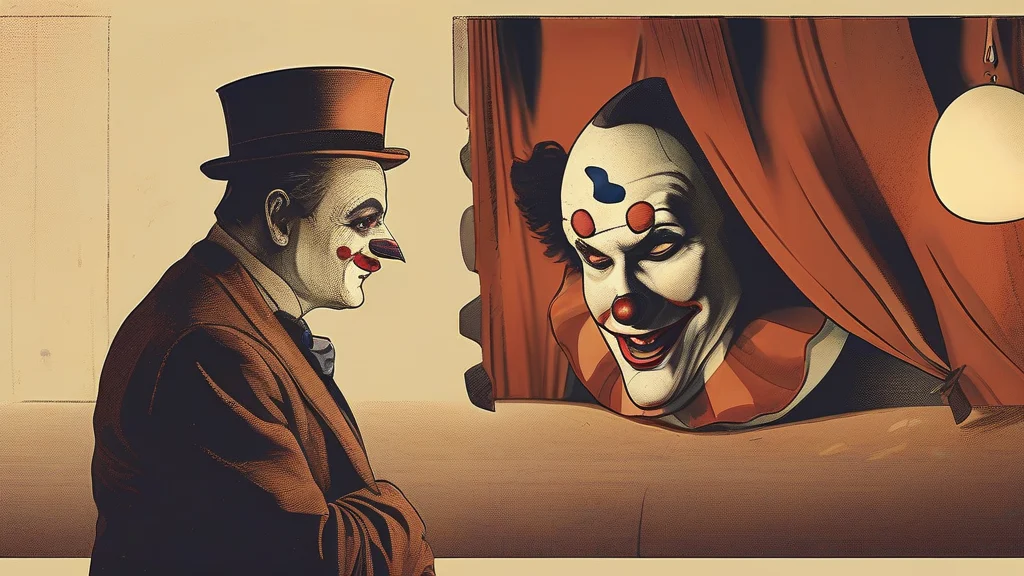
What does clown mean?
A clown is a comic entertainer whose trade is making people laugh, most famously through the exaggerated makeup, baggy costumes, and slapstick routines associated with circuses. Beyond the literal performer, the word is widely used figuratively: calling someone a clown suggests they are silly, playful, or not to be taken seriously, and the phrase 'the class clown' refers to the student known for constant joking. As a verb, 'to clown around' means to behave in a goofy, unproductive way. The word carries a dual connotation — it can be affectionate, celebrating good humor, or dismissive, implying incompetence. Historically, 'clown' entered English in the sixteenth century meaning a rustic peasant or boorish countryman before evolving through stage comedy into the circus figure familiar today. Its versatility across noun and verb uses makes it a common and expressive word in both casual speech and writing.
A comic entertainer who wears exaggerated makeup and costume and performs slapstick or absurd routines, especially in a circus; more broadly, a person who acts in a silly or buffoonish way.
"A clown juggled flaming torches while riding a unicycle across the ring."
When applied to people outside entertainment contexts, the noun can range from affectionate teasing to outright insult depending on tone.
(informal) To behave playfully, comically, or foolishly, especially at an inappropriate moment.
"The kids spent the afternoon clowning around instead of cleaning their room."
Almost always appears in the phrase 'clown around' or 'clown about'; used chiefly in informal British and American English.
Regular plural formation; used both literally for performers and figuratively for silly or foolish people.
"Three clowns squeezed out of a tiny car to thunderous applause."
The word 'clown' first appeared in English meaning simply 'a clumsy, boorish farmhand' — the red-nosed circus figure we know today didn't come along until decades later.
Reviewed by Deb Chak, Editor. AI-assisted content curated by RJS Tech Solutions LLP.
Etymology of clown
The word clown entered English in the sixteenth century, originally denoting a peasant, rustic, or boorish fellow. Its precise origin is uncertain, though it is often linked to Scandinavian words for a clumsy fellow, such as Icelandic 'klunni'. By the late sixteenth and seventeenth centuries the term had been adopted on the English stage for comic rustic characters, notably in Shakespeare, and over time it shifted toward the professional jester and eventually the painted circus entertainer of the eighteenth and nineteenth centuries. Related derivative forms include the adjective 'clownish' and the noun 'clowning'.
Related word forms
How clown is actually used
As a verb ('to clown', 'to clown around') the word is informal and slightly dated but still understood. The noun can be affectionate ('he's such a clown' said warmly) or mildly insulting when it implies incompetence or unseriousness.
Easily confused with clown
Cloven means split or divided into two parts (as in cloven hooves), while a clown is a comic performer or foolish person — they share only a similar spelling.