What does coachee mean?
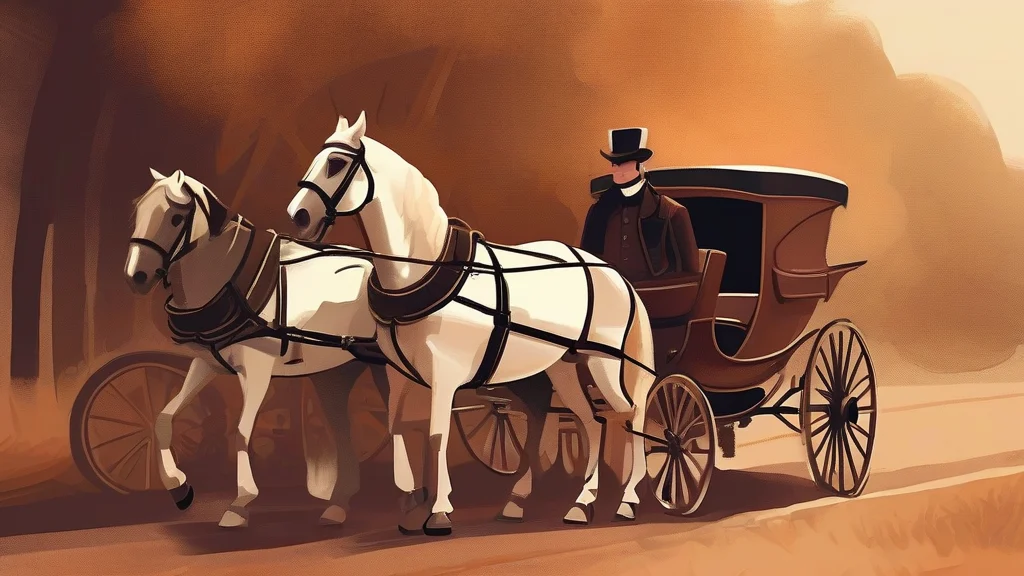
Coachee is a historical English noun denoting a light, four-wheeled horse-drawn carriage popular in the United States during the late eighteenth and early nineteenth centuries. Its defining feature was the absence of a driver's box: instead of sitting on an elevated seat, the person guiding the vehicle rode directly on the back of one of the two horses drawing it, making it lighter and cheaper than a full coach. A secondary, much rarer sense refers simply to a passenger travelling inside a coach. Today the word survives almost exclusively in historical documents, travel narratives, and antiquarian writing about early American roads and transport. Though obsolete, it remains a vivid reminder of how finely graded the vocabulary of horse-drawn vehicles once was, when terms like coach, gig, phaeton, and coachee each signalled a precise combination of body style, seating arrangement, and social standing.
nounA light, four-wheeled horse-drawn carriage of the late 18th and 19th centuries, typically seating passengers inside with the driver riding on one of the horses rather than on a box seat. More generally, a passenger being conveyed in a coach.
- A light American four-wheeled carriage without a driver's box, common in the late 18th and early 19th centuries.
- A passenger carried in a coach.
"The physician arrived at the plantation in his coachee, having ridden one of the horses himself."
"He drove up to the inn in a smart new coachee."
"Each coachee paid the fare before boarding the morning coach."
Regular plural; used when referring to multiple such carriages or passengers.
"By mid-morning several coachees had gathered outside the tavern."
In a coachee there was no driver's seat at all — the 'driver' literally sat on the back of one of the horses.
Reviewed by Deb Chak, Editor. AI-assisted content curated by RJS Tech Solutions LLP.
Etymology of coachee
Coachee was formed in English by adding the suffix -ee to coach, the vehicle name that entered English in the sixteenth century via French coche, ultimately from Hungarian kocsi, meaning 'carriage of Kocs', the Hungarian town associated with the vehicle's design. The word arose in the eighteenth century, chiefly in American usage, to name a lighter carriage lacking a coach's driver's box. It shares its root with related forms such as coachman, coaching, and coachwork.
Related word forms
How coachee is actually used
The word is now obsolete or purely historical, encountered mainly in period documents and literature describing early American travel. The passenger sense is rarer still and largely confined to older texts.
Easily confused with coachee
A coach is a larger, enclosed carriage driven from a box seat, whereas a coachee is a lighter carriage with no driver's box, the rider sitting on one of the horses.