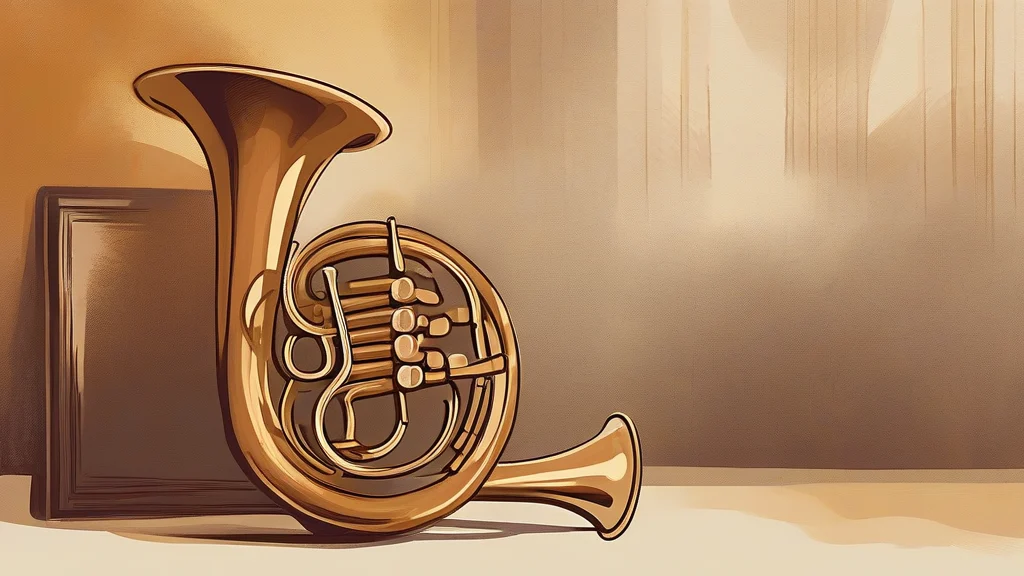
What does corno mean?
"Corno" is the Italian word for "horn," borrowed into English mainly through classical music, where Italian has long served as the standard language of scores and performance directions. In that context it most often denotes the (French) horn or one of its relatives, appearing in such established terms as "corno inglese" (the English horn, actually a type of oboe) and "corno di bassetto" (the basset horn). Outside music, the word surfaces in English chiefly when writers discuss Italian life, history, or place names. Like so many European words, it descends from the Latin "cornu," meaning horn — the same root that gave English "cornet," "cornucopia," and "unicorn." Because it is a borrowing rather than a fully naturalized English word, it keeps its Italian plural form "corni" in musical usage. For readers of orchestral parts or program notes, recognizing "corno" is a small but genuinely useful piece of musical literacy.
nounA borrowed Italian term for a horn, chiefly encountered in classical music contexts and Italian-language scores, where "corno" designates the (French) horn or a related brass or woodwind horn instrument.
- In music, a horn instrument, especially the (French) horn, as indicated in Italian-scored parts and directions.
- The Italian word for 'horn' more generally, occasionally borrowed into English writing about Italy or music.
"The score marked the passage corno solo, and the horn player rose to the challenge."
"The second movement opens with an extended corno solo over muted strings."
"On the hills above the village, a herdsman still sounded his corno at dusk."
As an Italian borrowing, "corno" takes the Italian plural "corni" rather than an anglicized "cornos," especially in musical contexts.
"The symphony's slow movement features two corni in dialogue with the strings."
When an Italian score calls for a "corno," it isn't asking for a piece of a bull — it's calling for the French horn, a direct descendant of the Latin word cornu.
Reviewed by Deb Chak, Editor. AI-assisted content curated by RJS Tech Solutions LLP.
Etymology of corno
"Corno" derives directly from Latin "cornu," meaning "horn" both as an animal's horn and as a wind instrument made from one. The Latin root also produced the Roman military horn called the cornu, as well as a family of English derivatives including "cornet," "cornucopia," "cornea," and "unicorn." English acquired the Italian form largely through musical terminology, since Italian was the international language of classical music from the Renaissance onward.
Related word forms
How corno is actually used
"Corno" is not an established everyday English word; it appears almost exclusively in musical contexts (often in fixed Italian terms), in discussions of Italian language and culture, and in proper names. It retains its Italian plural "corni" in musical usage.
Easily confused with corno
A cornet is a specific valved brass instrument resembling a small trumpet, whereas corno is the Italian generic word for a horn.
Cornu is the Latin word for 'horn' (also an ancient Roman curved brass instrument), while corno is its Italian descendant.