
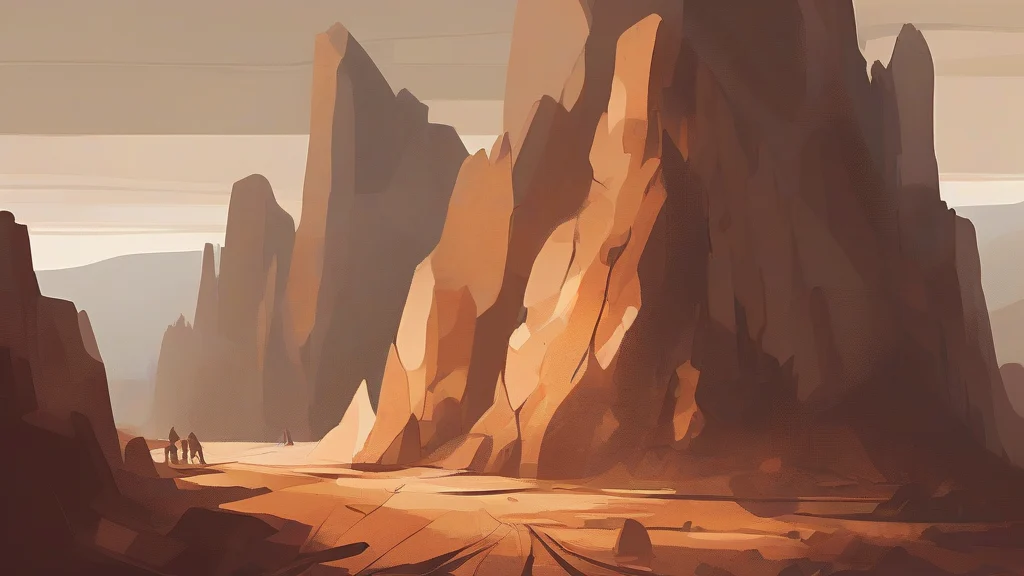
What does craggier mean?
Craggier is the comparative form of craggy, an adjective used to describe something marked by crags — steep, rugged masses of rock. A landscape described as craggier is rougher, more broken, and more strewn with jagged outcrops than another: hikers might note that one trail crosses craggier ground than a gentler neighbouring route. The word also extends figuratively to human features, where a craggier face suggests stronger, more angular lines, often with connotations of weathering, age, and rugged character rather than mere unattractiveness. It appears frequently in travel writing, mountaineering literature, nature journalism, and portrait description. The underlying noun 'crag' derives from a Celtic word for a steep, rocky place. Because it expresses comparison, craggier always implies a contrast between two things — one terrain, cliff, or face being rougher or more angular than another.
adjective (comparative form)The comparative form of 'craggy', meaning having more crags or a rougher, more rugged, rock-strewn surface; by extension, more uneven or angular in appearance.
- (of terrain, rocks, or cliffs) Having more crags; rougher and more rugged in surface
- (of a face or features) More strongly lined, angular, or weathered in appearance
"The northern route to the summit proved far craggier than the gentle southern path."
"As the trail climbed higher, the landscape grew steadily craggier and harder to cross."
"Years at sea had left his features craggier than she remembered."
'Craggier' doesn't just describe mountains — it's the word critics reach for when describing the famously weathered, chiselled faces of ageing film stars and sea-worn cliffs alike.
Reviewed by Deb Chak, Editor. AI-assisted content curated by RJS Tech Solutions LLP.
Etymology of craggier
Craggier derives from 'craggy', which combines 'crag' — meaning a steep, rugged rock or cliff — with the common adjectival suffix '-y'. The noun 'crag' entered English from Celtic sources: it corresponds to Welsh 'craig' and Irish 'carraig', both meaning rock, and is generally thought to be borrowed from one of these Gaelic or Brittonic forms during the medieval period, particularly in northern and western Britain where such terrain dominates. The comparative suffix '-ier' was added through ordinary English inflection.
Related word forms
How craggier is actually used
Used almost exclusively as the comparative of 'craggy' ('craggier') or superlative ('craggiest'); the base adjective is far more common than its inflected forms. Applied literally to landscape and figuratively to human features. Register is neutral — found equally in travel writing, nature journalism, and everyday description.
Easily confused with craggier
'Crabbier' means more bad-tempered or irritable, while 'craggier' describes a rougher, more rock-covered physical surface.