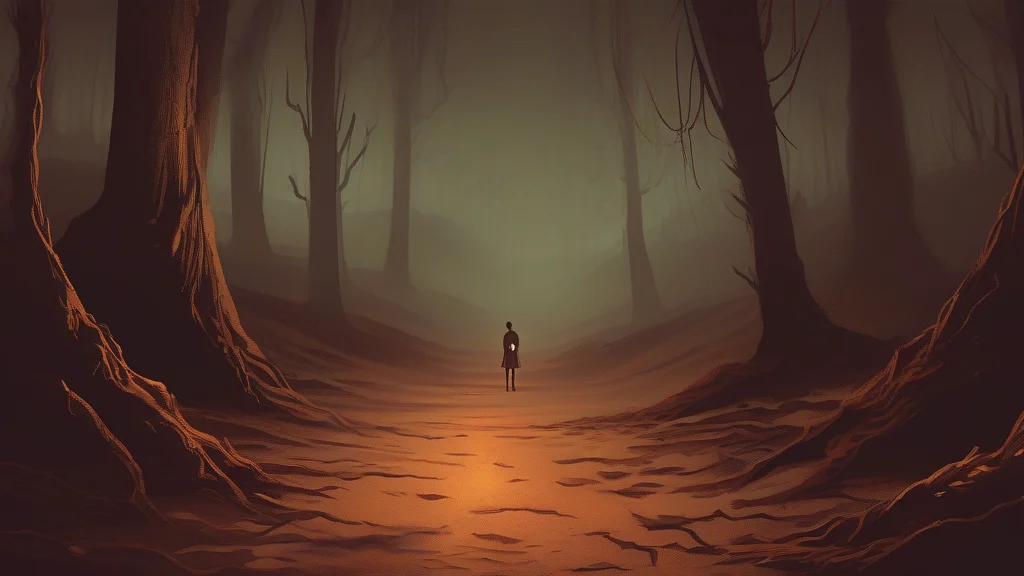
What does creepiest mean?
'Creepiest' is the superlative form of the adjective 'creepy', used to describe whatever inspires the greatest degree of unease, fear, or quiet dread among the things being compared. Where ordinary fear words suggest open danger, 'creepy' — and by extension 'creepiest' — points at something more subtle: an atmosphere of wrongness, strangeness, or menace that makes the skin crawl without any obvious threat. It is frequently applied to places such as abandoned buildings, to objects like old photographs or dolls, to sounds and stories, and informally to people whose behaviour feels intrusive or predatory. The word is firmly established in everyday English across British and American usage, appearing in casual conversation, horror fiction, film reviews, and internet culture, where ranking 'the creepiest' scenes or characters has become a popular pastime. Its connotations are almost entirely negative, though often tinged with dark fascination rather than outright terror, making it a favourite for evoking shivers rather than screams.
adjective (superlative of 'creepy')The superlative form of 'creepy'; most causing an unpleasant feeling of fear or unease, especially in a strange or unsettling way.
- Most causing an unpleasant feeling of fear or uneasy suspense; supremely eerie or disturbing.
- (Informal) Most suggestive of a person who behaves in a socially inappropriate, unsettling, or predatory way.
"The basement of the abandoned asylum was the creepiest place any of them had ever explored."
"The old doll with its chipped porcelain face was the creepiest object in the entire antique shop."
"Voters agreed he was the creepiest character ever to appear on the show."
From the slow crawl of a caterpillar to haunted-house dread — 'creepiest' began with literal creeping before it gave us goosebumps.
Reviewed by Deb Chak, Editor. AI-assisted content curated by RJS Tech Solutions LLP.
Etymology of creepiest
'Creepiest' derives from 'creepy', which emerged in nineteenth-century English from the verb 'creep', itself rooted in Old English 'crēopan', meaning to bend the body or move slowly along the ground. While 'creep' originally described physical crawling motion, as in insects and reptiles, 'creepy' developed figuratively to describe sensations of horror or revulsion — echoing phrases like the skin-crawling effect attributed to such creatures. The superlative form follows standard English morphology, and cognates of the root appear in other Germanic languages, such as Dutch 'kruipen' and German 'kriechen'.
Related word forms
How creepiest is actually used
Informal to neutral register; common in everyday speech, journalism, and pop-culture criticism. The informal sense applied to people carries strong negative connotation and can feel insulting, so use with care.
Easily confused with creepiest
'Crept' is the past tense of the verb 'creep' (to move slowly and quietly), whereas 'creepiest' is a superlative adjective describing something maximally frightening or unsettling.