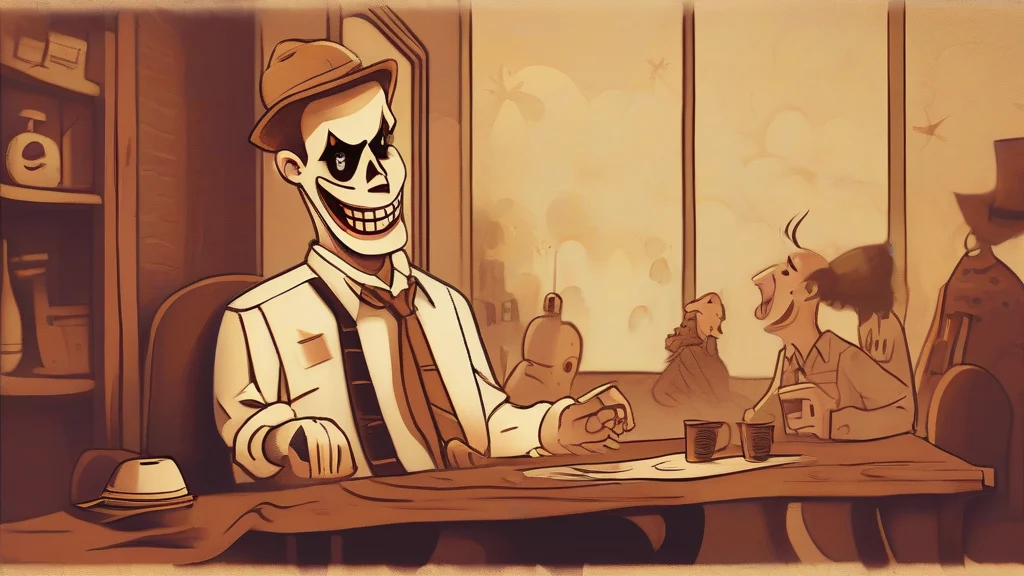
What does cutup mean?
A cutup is a person who delights in making others laugh through jokes, pranks, and general high-spirited clowning. The term is chiefly informal American English, applied affectionately rather than critically: the office cutup lightens tense meetings, and the class cutup keeps classmates entertained at the teacher's expense. Calling someone a cutup implies good humor and harmless mischief rather than cruelty or disruption, which distinguishes it from harsher labels like troublemaker. The word arises straightforwardly from the verb phrase "cut up," long used figuratively to describe boisterous, silly behavior. Though the noun form without a hyphen is now standard for this sense, writers should be aware that the hyphenated "cut-up" refers instead to a literary technique of slicing and reassembling text, associated with William S. Burroughs. For anyone describing the resident joker of a group — in yearbooks, eulogies, or everyday conversation — cutup remains the natural, fondly used choice.
nounA person who habitually clowns around, plays practical jokes, or makes witty remarks in order to amuse others.
- A person who habitually jokes, pranks, or behaves in an amusingly mischievous way to entertain others.
"Everyone knew Marco was the class cutup, always ready with a joke even during the most solemn assemblies."
"The wedding toast turned into pure comedy once the best man, a lifelong cutup, took the microphone."
"Teachers described Danny as a good-natured cutup who could derail a lecture with a single well-timed remark."
Standard pluralization applies; commonly seen in plural phrases like "classroom cutups."
"The reunion brought together all the old cutups who once ran the school's prank scene."
The word for the class clown literally just smashes "cut" and "up" together — the same phrase your mother used when she told you to stop fooling around.
Reviewed by Deb Chak, Editor. AI-assisted content curated by RJS Tech Solutions LLP.
Etymology of cutup
"Cutup" derives from the English verb phrase "to cut up," which by the nineteenth century had acquired the figurative sense of behaving in a wild, clownish, or disruptive manner — hence "cutting up" in public. The compound noun formed from this phrase came to name the habitual practitioner of such behavior, becoming especially established in informal American usage. Its roots therefore lie entirely within English, built on the verb "cut," and it shares that base with other cut-derived compounds such as cutter, cutlass, and cutaway.
How cutup is actually used
"Cutup" is informal American English and carries a warm, affectionate connotation — it suggests playful mischief rather than malice. It is common in casual speech and journalism but out of place in formal writing.
Easily confused with cutup
"Cut-up" (usually written with a hyphen) refers to a literary collage technique of slicing and rearranging text, popularized by William S. Burroughs, whereas "cutup" names a person who jokes and clowns around.
"Cutthroat" describes someone ruthlessly competitive or murderous, while "cutup" describes a harmless joker.