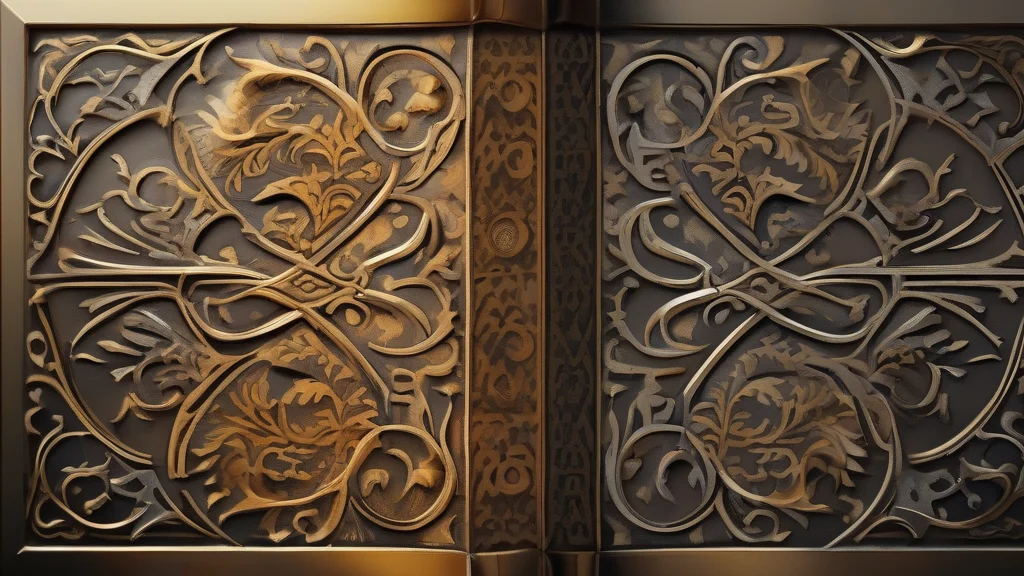
What does damaskeening mean?
Damaskeening is the decorative art of ornamenting metal—most often steel or iron—with intricate patterns inlaid in gold or silver, a technique named for Damascus, the Syrian city long celebrated for its superbly crafted blades. The resulting work may feature scrolling vines, geometric motifs, or flowing lines that catch the light against the darker base metal. Historically, damaskeening adorned swords, firearms, armor, and later precision objects such as watch cases and clock movements, where it signaled luxury and expert handiwork. The word derives from the verb 'to damaskeen,' itself rooted in the place-name Damascus via the broader word 'damask.' Today the term survives mainly among collectors, conservators, and historians of decorative arts, who encounter it in auction catalogs and museum descriptions. It carries connotations of refinement, antiquity, and meticulous craftsmanship rather than casual use.
The art or process of ornamenting metal with intricate inlaid designs of gold or silver.
"The gunsmith's catalog highlighted the damaskeening on each engraved receiver."
Chiefly used in contexts of antique arms, armor, and horology.
Ornamental metalwork produced by this inlaying technique.
"Fine damaskeening covered the lock plate of the flintlock pistol."
The name traces back to Damascus, the Syrian city whose metalworkers were so famed for ornate blades that 'Damascus steel' became a byword for craftsmanship centuries later.
Reviewed by Deb Chak, Editor. AI-assisted content curated by RJS Tech Solutions LLP.
Etymology of damaskeening
Damaskeening ultimately takes its name from Damascus, the ancient Syrian capital renowned from medieval times for its finely worked metalware and legendary steel blades. The English verb 'damaskeen,' from which the noun derives, entered use in the early modern period alongside related terms like 'damask' and 'damascene,' all tracing back to the city's name. The suffix '-een' reflects influence from French forms used in describing such ornamentation.
Related word forms
How damaskeening is actually used
A technical term found chiefly in discussions of antique arms, armor, horology, and fine metalwork; rare in everyday speech.
Easily confused with damaskeening
Damaskeening refers specifically to inlaying gold or silver into metal to form patterns, while damascening is a broader term for surface-decorating metal that can include etching or watered-steel effects.