What does desolated mean?
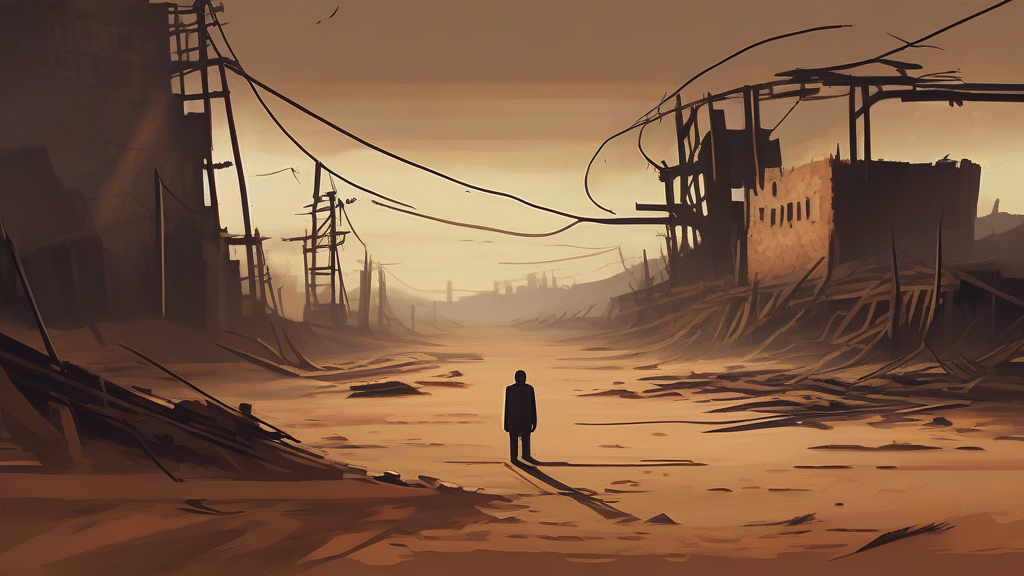
Desolated describes a state of profound emotional devastation — grief so complete it leaves a person feeling empty and alone. It can also describe physical places: land, towns, or landscapes that have been laid waste, stripped bare, or abandoned to ruin. The word derives from the Latin desolare, meaning to leave alone or abandon, built on solus, meaning alone; this root also gives us solitary, solitude, and solo. As an adjective, desolated carries a formal, literary register, appearing more often in novels, obituaries, and elegiac prose than in casual conversation. It conveys something deeper than ordinary sadness — a sense of loss so total that recovery feels uncertain. Writers reach for it when they want to evoke both inner anguish and outward desolation, whether describing a widower's grief or a war-scarred countryside left silent and barren.
Utterly wretched with grief or misery; also, of a place, reduced to ruin or emptiness.
"She was desolated by the loss of her oldest friend."
Formal and literary in tone; stronger and more emotive than 'sad' or 'upset'.
Past tense and past participle of desolate: to make someone deeply unhappy, or to ravage and lay waste a place.
"War desolated the region for generations."
The word 'desolate' hides the Latin 'solare' — to make lonely — which is why 'desolated' literally means 'made solitary,' even when you're surrounded by people.
Reviewed by Deb Chak, Editor. AI-assisted content curated by RJS Tech Solutions LLP.
Etymology of desolated
Desolated comes from the past participle of the verb desolate, which entered English from Latin desolatus, the participle of desolare — 'to leave all alone' or 'to abandon' — formed from de- ('thoroughly') plus solare ('to make lonely'), itself derived from solus, meaning 'alone.' The same Latin root produced English words such as solitary, solitude, solo, and console, all sharing the idea of aloneness. The adjective sense of desolated, describing both devastated people and ruined places, has been in use since the early modern period.
Related word forms
How desolated is actually used
When applied to people, 'desolated' is formal and strongly emotive, more literary than everyday speech. When applied to places, it emphasizes ruin and emptiness rather than mere sadness.
Easily confused with desolated
Dissected means cut apart for examination; desolated means made miserable or laid waste — they share only a similar visual shape.