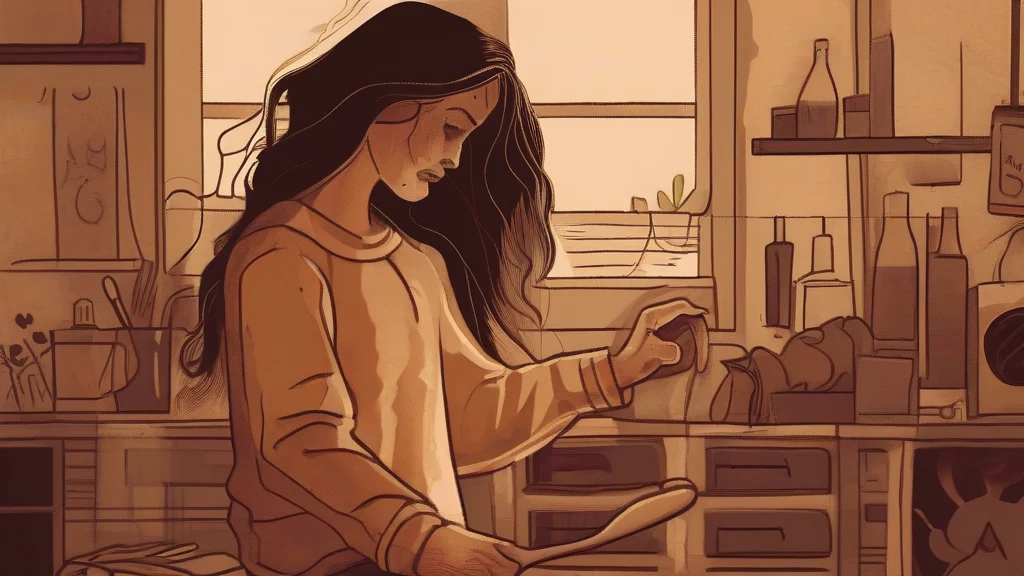
What does disheveling mean?
"Disheveling" is the present participle of the verb "dishevel", meaning to make someone's hair, clothing, or overall appearance untidy, rumpled, or thrown into disorder. It typically appears in descriptive writing to convey motion or process — wind disheveling hair, a struggle disheveling clothes, grief disheveling a once-immaculate figure. The word carries a distinctly literary flavor: in casual conversation most speakers prefer "tousling", "rumpling", or "messing up", reserving "dishevel" for polished prose. Its history points back through Middle English to Old French "chevel", meaning hair, which ultimately derives from the Latin "capillus", a single hair — the same root behind "capillary". This makes the word a small etymological curiosity, linking everyday untidiness to the anatomy of a single strand. Related forms include the far more common adjective "disheveled" and the noun "dishevelment", both of which describe the resulting state rather than the act of causing it.
Present participle of 'dishevel': to make someone's hair or appearance untidy, rumpled, or disordered.
"The children came running indoors, the wind disheveling their hair and filling it with leaves."
Almost always used transitively, with the person or thing being made untidy as the object.
As a gerund, the act or process of making something untidy or disordered.
"A little disheveling of his usually precise appearance did him no harm at all."
Rare; the noun 'dishevelment' is the usual nominal form for the resulting state.
Hidden inside 'disheveling' is the Latin word for a single strand of hair — 'capillus', the same root that gives us 'capillary'.
Reviewed by Deb Chak, Editor. AI-assisted content curated by RJS Tech Solutions LLP.
Etymology of disheveling
Disheveling derives from the verb 'dishevel', which entered English in the late Middle Ages via Middle English 'disheveled', originally meaning to let the hair hang loose. The stem comes from Old French 'chevel' (hair), from Late Latin 'capellus', a diminutive related to Latin 'capillus', meaning hair. English shares this root with words such as 'capillary' and the French borrowing 'chevelure'. Over time the verb broadened from describing loosened hair to any rumpling or disordering of appearance.
Related word forms
How disheveling is actually used
Somewhat literary in register; everyday speech more often uses 'tousling' or 'messing up'. The simple adjective 'disheveled' is far more common than the participle.
Easily confused with disheveling
Unraveling means coming apart or unwinding into disorder, while disheveling specifically means making hair or appearance untidy and rumpled.