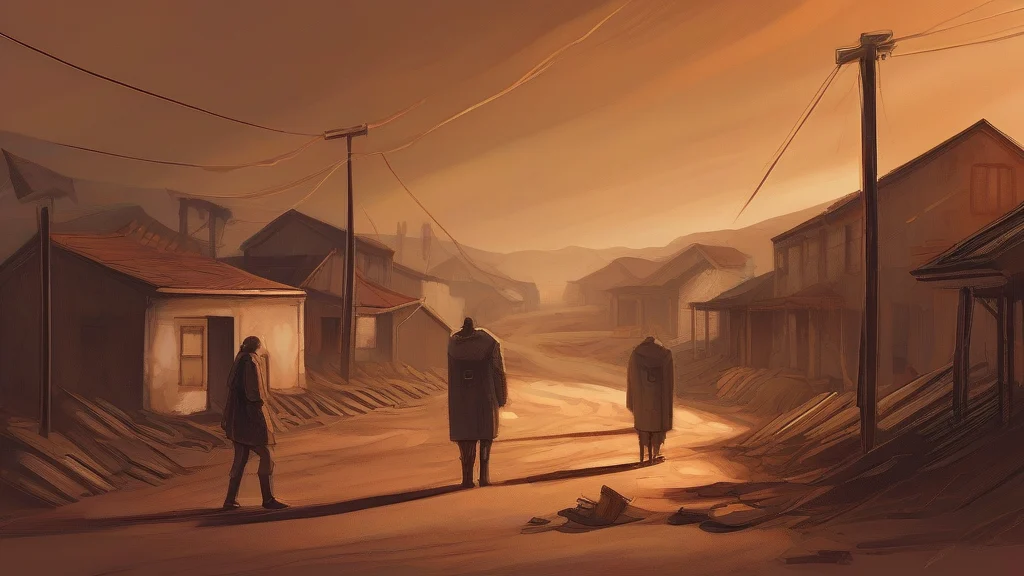
What does dispeopling mean?
Dispeopling refers to the act or process of depriving a place of its inhabitants — emptying a town, region, or nation of its people. It functions both as the present participle of the verb 'to dispeople' and as a noun describing the resulting condition of depopulation. The causes implied are varied: war, famine, plague, forced expulsion, economic decline, or mass emigration may all bring about the dispeopling of a territory. The word belongs to a literary register and appears most often in historical narrative and descriptive prose, where it lends gravity to accounts of abandoned settlements and emptied landscapes; in ordinary modern usage, 'depopulation' and 'depopulate' have largely taken its place. It derives simply from the prefix 'dis-' attached to 'people' used as a verb, meaning to remove the people from somewhere. Its opposite is 'repeople' or 'repeopling', the restoration of inhabitants to a once-deserted place.
Stripping a place of its inhabitants; causing a town, region, or country to become empty of people.
"Successive invasions were rapidly dispeopling the borderlands."
Almost always found in formal or historical prose; 'depopulating' is preferred in everyday contexts.
The act or process by which a place loses its inhabitants; large-scale depopulation of a particular area.
"The dispeopling of the Hebrides accelerated throughout the nineteenth century."
Typically preceded by an article or possessive, as in 'the dispeopling of the region'.
'Dispeopling' sounds like science fiction, but it has been used for centuries to describe something grimly real — the quiet emptying out of towns and nations.
Reviewed by Deb Chak, Editor. AI-assisted content curated by RJS Tech Solutions LLP.
Etymology of dispeopling
Dispeopling is formed within English from the verb 'to dispeople', itself a straightforward combination of the prefix 'dis-' (indicating reversal or removal) with 'people' used as a verb, meaning to populate or furnish with inhabitants. The underlying word traces back through Old French 'peuple' to Latin 'populus', meaning a people or nation, which also gives us 'popular', 'population', and 'populace'. The verb arose in English usage around the late sixteenth century, when writers needed terms for conquests, plagues, and clearances that emptied whole regions, and its participial form followed naturally.
Related word forms
How dispeopling is actually used
A literary and somewhat archaic term; 'depopulate' and its derivatives are far more common in modern usage. 'Dispeopling' tends to appear in historical writing and elevated prose, often carrying connotations of tragedy or deliberate removal.
Easily confused with dispeopling
Both mean removing inhabitants from a place, but 'dispeopling' is the rarer, more literary synonym formed directly from 'people', while 'depopulating' is the standard modern term.
'Displacing' means forcing people to move from their homes or positions generally, whereas 'dispeopling' refers specifically to emptying a place or region of its population.