What does dorbug mean?
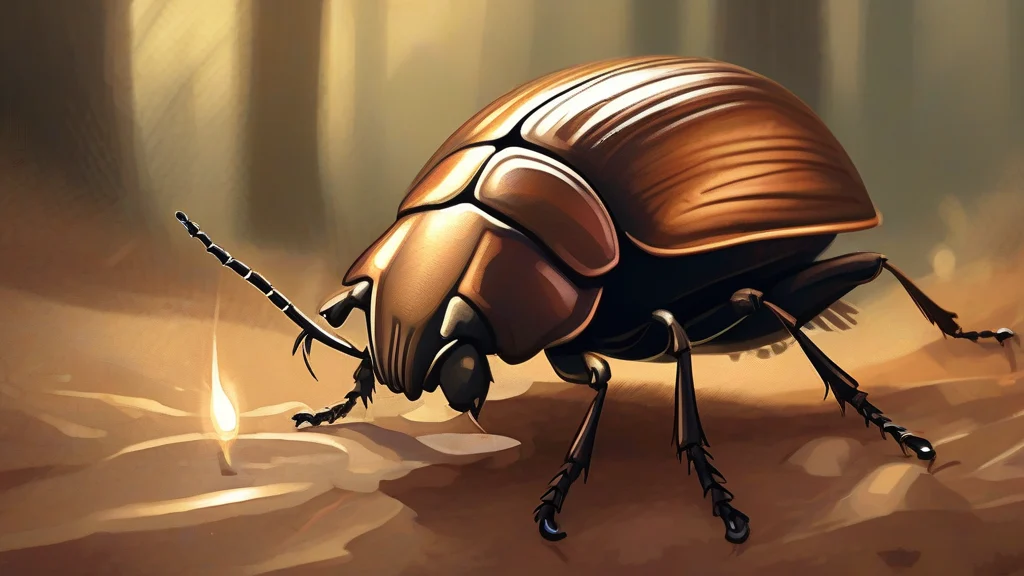
Dorbug is an informal, chiefly American regional name for the June beetle — one of several species of large, rusty-brown scarab beetles that emerge in late spring and early summer across eastern North America. These beetles are famous for their clumsy, buzzing night flights and their habit of blundering into porch lights and window screens, which makes the word a fixture of warm-weather childhood memories. The name joins 'dor,' an ancient English word for a beetle, with the familiar 'bug.' Though entomologists prefer terms like May beetle or June beetle, dorbug endures in rural and Southern speech as a folksy, affectionate label for a harmless seasonal nuisance whose grubs feed on grass roots underground. For readers, it offers a charming glimpse of dialect vocabulary tied closely to place and season.
nounA large brown scarab beetle, especially a June beetle (June bug), that flies noisily and is often attracted to lights in late spring and early summer.
- A June beetle or May beetle — any of several large brown scarab beetles common in eastern North America that fly clumsily, often noisily, toward lights on warm evenings.
- Loosely and regionally, any large slow-flying beetle regarded as a harmless nuisance.
"On summer evenings the porch light drew every dorbug within half a mile."
"Every June the dorbugs thudded against the kitchen window screen after dark."
"Grandpa called them dorbugs, never June bugs, no matter what the field guide said."
Regular plural; typically used when referring to the seasonal swarms of beetles appearing in early summer.
"By mid-June the dorbugs were swarming the streetlights every night."
The clumsy dorbug crashing against your porch light has been bumping around English since before Shakespeare — its 'dor' root is over a thousand years old.
Reviewed by Deb Chak, Editor. AI-assisted content curated by RJS Tech Solutions LLP.
Etymology of dorbug
The first element, 'dor,' comes from Middle English 'dor' meaning a beetle or drone, descended from Old English 'dora,' a word for a stinging insect or bee. It combines with 'bug,' originally meaning a frightening spirit or insect, to form dorbug. The related form 'dorbeetle' appears earlier in British English for similar dung-feeding scarabs; dorbug developed as the American counterpart applied to June beetles. Cognate uses of 'dor' survive in archaic words like 'dumbledore' (a bumblebee in dialect).
How dorbug is actually used
Dorbug is informal and distinctly regional American English; it survives mainly in rural speech and dialect writing. Most Americans today say 'June bug' or 'May beetle' instead, so the word may puzzle listeners outside its home territory. It carries folksy, nostalgic connotations rather than any scientific precision.
Easily confused with dorbug
Dorbeetle is the older chiefly British name for a similar dung-feeding scarab, while dorbug is the American regional term most often applied to the June beetle.
A dung beetle feeds on animal droppings and rolls them into balls, whereas the dorbug (June beetle) is a foliage-and-root feeder active at dusk.