What does dreamland mean?
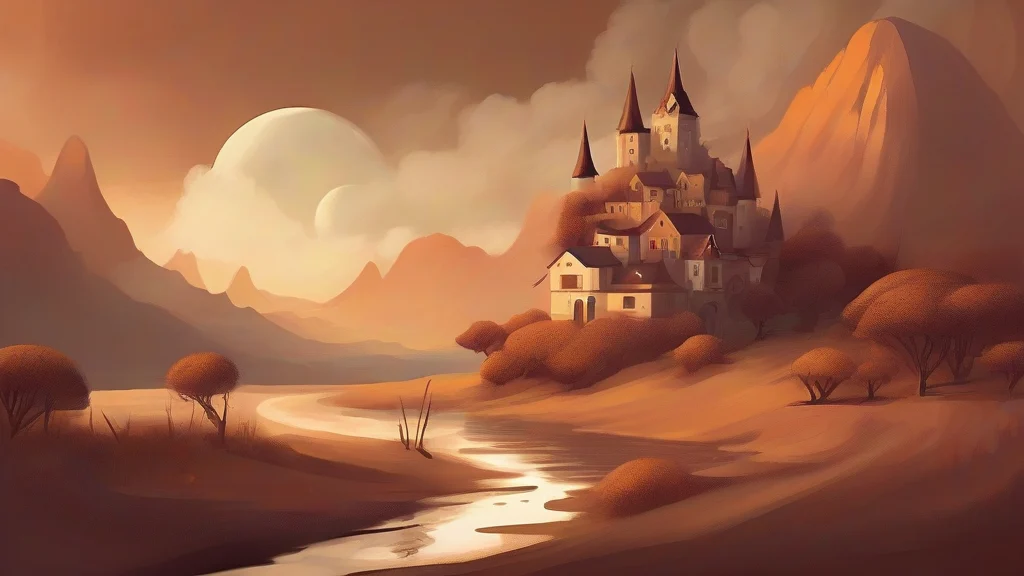
Dreamland is a noun that names two closely related realms: the imaginative world we inhabit while asleep, and any blissful, idealized place of fantasy or illusion. In its most familiar use, it is affectionate and informal — children are sent 'off to dreamland,' and adults joke about being 'back in dreamland' upon waking. Its figurative sense extends this to waking life: plans, beliefs, or attitudes described as existing in dreamland are charming but detached from practical reality, giving the word a gently mocking edge in criticism. The term combines the Old English-rooted noun 'dream' with the Germanic element 'land,' and it gained wide popularity in nineteenth-century English, even lending its name to famous amusement parks that promised a real-life version of its magic. Whether describing slumber or wishful thinking, dreamland evokes comfort, escape, and the pull of the imagination.
The state of sleep or the realm of dreams experienced during sleep.
"He was whisked away to dreamland almost the moment his head touched the pillow."
Often used informally and affectionately, especially regarding children.
An idealized or fantastical realm of imagination; a state of blissful detachment from reality.
"Her critics accused her of living in dreamland if she thought the budget would pass unchanged."
Frequently carries a mildly dismissive connotation, implying naivety or impracticality.
Rarely used; the plural appears mainly in literary or descriptive contexts referring to multiple distinct imaginary worlds.
"The novel wanders through the dreamlands of several sleeping characters."
"Dreamland" was popularized in the 19th century as Coney Island's most famous amusement park — a real place named after the one in your head.
Reviewed by Deb Chak, Editor. AI-assisted content curated by RJS Tech Solutions LLP.
Etymology of dreamland
Dreamland is a compound of Middle English 'dream' (from Old English 'drēam,' originally meaning joy or music before shifting to mean a vision during sleep) and 'land,' from Old English 'land.' It arose as a native English formation rather than a borrowing, becoming common in the nineteenth century, when writers used it for the world of sleep and for imaginary utopias. Its elements tie it to a broad family of Germanic compounds such as 'homeland,' 'farmland,' and 'wonderland.'
How dreamland is actually used
Informal to neutral in register. The sleep sense is warm and often affectionate (especially with children), while the figurative sense can be mildly critical, suggesting someone is out of touch with reality. Commonly used without an article ('off to dreamland').
Easily confused with dreamland
'Dream world' is a more literal or technical term for the imaginary environment of a dream, while 'dreamland' is the broader, often whimsical word for both sleep-dreams and any idyllic imagined realm.