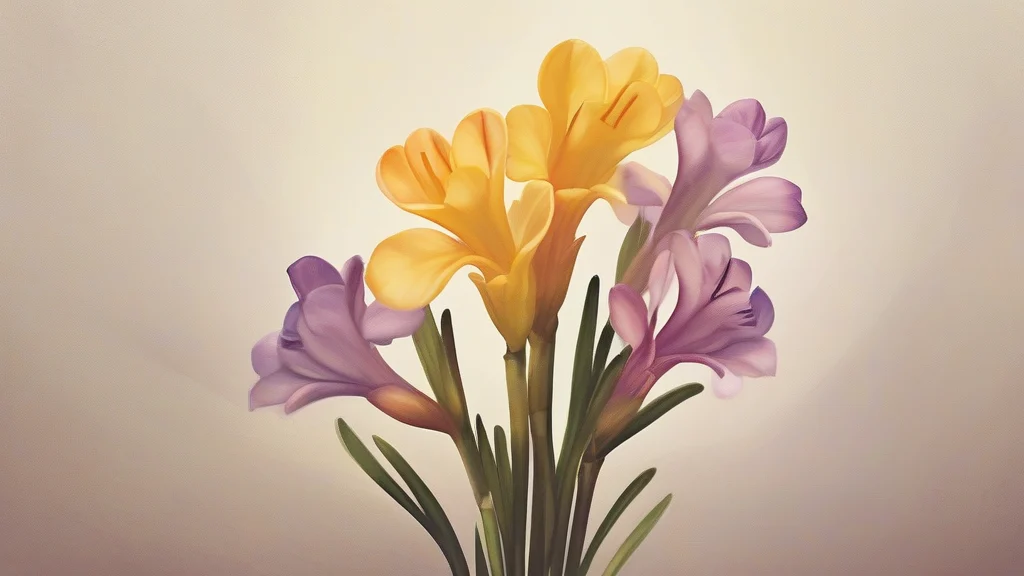
What does freesia mean?
Freesia is a genus of southern African flowering plants prized above all for their fragrance and delicate, trumpet-shaped blossoms, which appear in white, yellow, pink, red, and purple. Grown from corms, freesias flourish in gardens in mild climates and are equally at home in florists' bouquets, where their sweet, fresh scent makes them one of the most sought-after cut flowers. The name honors Friedrich Freese, the nineteenth-century German botanist after whom the genus was named. In modern usage the word turns up most often in three settings: gardening advice about planting freesia bulbs, wedding and floral design, and perfumery, where freesia is a popular fragrance note in soaps, candles, and fine scents. It carries pleasant, romantic connotations — trust and innocence are traditionally attached to it in the language of flowers — making "freesia" a small but evocative vocabulary addition.
nounA southern African plant of the genus Freesia, cultivated for its clusters of fragrant, funnel-shaped flowers in shades of white, yellow, pink, and purple; the scented blossom of this plant, widely used in bouquets and perfumery.
- The herbaceous cormous plant of the genus Freesia, grown for its showy, fragrant flowers.
- The flower of this plant, especially when cut and used in arrangements or as a perfume note.
"The bride carried a bouquet of white freesias that perfumed the entire church."
"She planted freesia corms along the border so the path would smell of them by spring."
"A single stem of freesia stood in a slim vase on the desk, filling the room with its clean, sweet fragrance."
Standard English plural; occasionally the uninflected "freesia" is used collectively when referring to multiple plants growing together.
"The arrangement combined roses with sprigs of freesias and eucalyptus."
The freesia isn't just a pretty face in the bouquet — it's named after a real person, German botanist Friedrich Freese, and its unmistakable scent has made it a fixture of fine perfumery.
Reviewed by Deb Chak, Editor. AI-assisted content curated by RJS Tech Solutions LLP.
Etymology of freesia
Freesia takes its name from Friedrich Heinrich Theodor Freese, a nineteenth-century German physician and botanist who studied South African plants; the Danish botanist Frederik Vibe Eckersberg-Lund (often credited through early botanical literature) coined the genus name in his honor. The plants themselves are native to southern Africa, from which they were introduced to European cultivation in the nineteenth century and quickly became popular greenhouse and garden flowers. As an eponym, the word shares its origin with no classical root, though it sits comfortably among other botanical names derived from people.
Related word forms
How freesia is actually used
In everyday use, "freesia" almost always refers to the flower rather than the whole plant, and it appears most often in gardening, floristry, and fragrance contexts — a fairly neutral, even elegant register. The plural is usually "freesias" in ordinary speech, though "freesia" is sometimes treated as collective when discussing beds of the plant.
Easily confused with freesia
Fuchsia is a different flowering shrub with drooping, two-toned pendulous blooms, while freesia has upright, funnel-shaped, sweetly scented flowers; the two are often muddled because of their similar spellings.