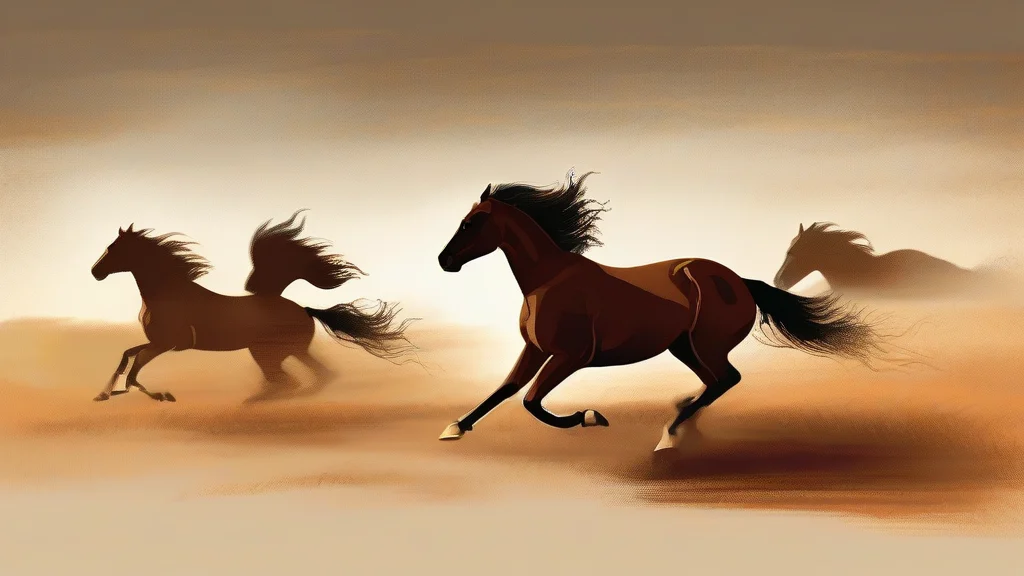
What does galloped mean?
To gallop is to travel at the fastest natural gait of a horse — a powerful, four-beat stride in which all four hooves leave the ground simultaneously — and 'galloped' is simply the past tense form of that verb. In everyday language it describes a horse that has been ridden or driven at this top speed, whether across a racetrack, a battlefield, or an open field. The word also carries a well-established figurative life: time, news, and events are often said to have galloped along when they move with startling speed. Because the gallop conveys power, urgency, and freedom, sentences using 'galloped' tend to evoke vivid motion and drama, which is why the word appears so frequently in historical fiction, racing commentary, and poetry. It remains a familiar and evocative term throughout the English-speaking world, instantly signalling both speed and equestrian imagery whenever it appears.
verb (past tense of 'gallop')Galloped is the past tense and past participle of 'gallop', meaning to have moved forward at the fastest natural pace of a horse, with all four feet off the ground in each stride. The term is also applied figuratively to people or things moving or proceeding very rapidly.
- To have ridden or driven a horse at its fastest four-beat gait, in which all four hooves are momentarily off the ground together.
- To have moved or proceeded very rapidly in a figurative sense, as in time galloping by or events rushing forward.
"The horse galloped across the open meadow, its mane flying in the wind."
"The cavalry galloped down the hill toward the enemy lines."
"The weeks seemed to gallop past as the deadline drew near."
A galloping horse is briefly airborne — there is a moment in every stride when all four hooves leave the ground, a fact famously proven by Eadweard Muybridge's pioneering 1878 photographs.
Reviewed by Deb Chak, Editor. AI-assisted content curated by RJS Tech Solutions LLP.
Etymology of galloped
The verb 'gallop', from which 'galloped' derives as its past tense, entered English from French during the late medieval period; the French word 'galoper' described the same rapid horse gait and was itself adopted into English by the fifteenth century. The ultimate origin of the French term is uncertain, though some scholars connect it to Germanic roots relating to running or jumping. Related forms such as the lively dance known as the galop, popular in nineteenth-century ballrooms, borrowed their name from the same gait, extending the word's reach beyond the stable into music and social dance.
Related word forms
How galloped is actually used
'Galloped' is chiefly used as the past tense of the verb 'gallop' and appears almost exclusively in narrative or descriptive contexts — literature, journalism about horse racing or riding, and figurative prose. Figurative uses (e.g. 'rumours galloped through the office') are common but should read as metaphor rather than literal description.
Easily confused with galloped
'Gallup' is most often associated with the Gallup polling organization and is a different word entirely, whereas 'galloped' refers to the fast four-beat gait of a horse.