
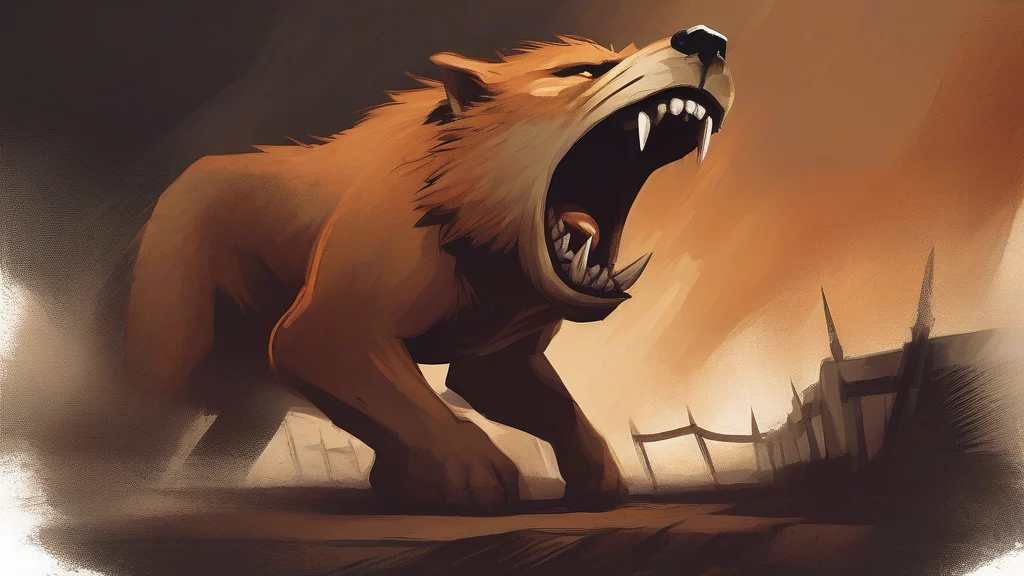
What does snarl mean?
To snarl is to make a harsh, low sound or to speak in an angry, threatening way. The word often suggests an abrupt, hostile reaction, especially from an animal, but it can also describe a person responding with irritation or resentment. As a noun, a snarl may be the sound itself, a visibly angry expression, or a complaint delivered with heat and displeasure. The verb is vivid and slightly dramatic, so it is especially effective when the speaker wants to convey aggression, defiance, or mounting annoyance. In everyday conversation, people might say that someone “snarled at” another person, while a writer might describe a fierce dog giving a low snarl. The word carries a distinctly negative emotional tone and is generally more forceful than a simple complaint.
To make a harsh, low, threatening sound, or to speak angrily and sharply.
"The dog backed away, snarling at the approaching stranger."
Often transitive when followed by an object, as in “snarl an order,” and intransitive when describing an angry vocalization.
A harsh, angry, or threatening sound, expression, or complaint.
"He responded with a snarl of frustration."
The noun can refer to an animal's vocalization, an angry facial expression, or a hostile verbal complaint.
The plural is used for individual angry sounds, expressions, or complaints.
"The room was filled with snarls of disagreement."
A snarl turns a moment of tension into a sound everyone can hear.
Reviewed by Deb Chak, Editor. AI-assisted content curated by RJS Tech Solutions LLP.
Where does snarl come from?
The word comes from Middle English, where forms related to snarlen were used for a rough or angry sound. Its development is associated with the idea of a low, rumbling vocalization, and the verb was extended by analogy to describe angry speech. The word is historically connected with snare through the older Germanic root *snar-, although the modern senses of the two words are distinct.
Related word forms
How snarl is actually used
The verb is commonly used for both animal sounds and people speaking angrily. The noun can describe a particular sound, an angry facial expression, or a strongly worded complaint.
Easily confused with snarl
A snare is a trap or a device used to catch something, whereas a snarl is an angry vocalization or complaint.
Scrunch means to crush or make a crunching sound, while snarl describes a harsh, hostile vocalization.