
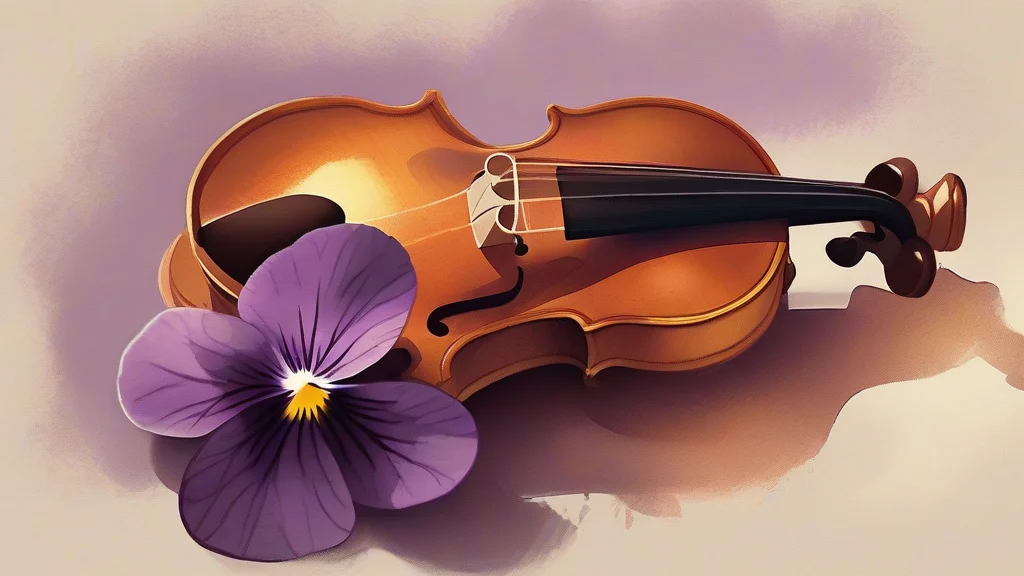
What does viola mean?
The word viola most commonly denotes a bowed string instrument belonging to the violin family. Its pitch lies between that of the violin and cello, and its warm, mellow tone makes it especially prominent in orchestral writing, chamber music, and string quartets. The instrument should not be confused with the violin, although the two are closely related and are often played by the same musicians. Viola also has a botanical meaning: it refers to flowering plants of the genus Viola, a group that includes violets and familiar garden pansies. Thus, the word can refer either to a substantial musical instrument or to a flowering plant. The musical sense is the dominant modern use, while the botanical sense is common in gardening, horticulture, and taxonomic contexts. In an ensemble, a violist is the musician who plays the viola.
nounA viola is a bowed string instrument in the violin family, larger and lower in pitch than a violin. In botany, viola also denotes a flowering plant of the genus Viola, including violets and pansies.
- A bowed string instrument of the violin family, larger and lower in pitch than a violin.
- A flowering plant of the genus Viola, including violets and pansies.
"She played the viola in the orchestra with a warm, expressive tone."
"He switched from violin to viola because he preferred its warmer timbre."
"Pansies are familiar garden varieties of Viola."
The standard plural is used for both instruments and plants in the genus Viola.
"Two violas stood ready at the front of the string section."
The viola occupies the musical middle ground between the bright violin and the resonant cello.
Reviewed by Deb Chak, Editor. AI-assisted content curated by RJS Tech Solutions LLP.
Where does viola come from?
The instrument sense entered English through Italian viola, from Medieval Latin viola, an old term for a stringed instrument. The botanical sense comes from Latin viola, meaning violet, and names the genus Viola. The instrument also belongs to the historical family of bowed-string instruments named through related forms such as viol, violone, and violoncello.
Related word forms
How viola is actually used
The player of a viola is normally called a violist. In botanical usage, Viola is also the scientific genus name and is conventionally italicized. The instrument name normally has initial stress, with the second syllable carrying the principal vowel sound.
Easily confused with viola
A viola is larger and lower-pitched than a violin and has a distinct middle register between the violin and cello.
A viola is an instrument, whereas a violet is a flowering plant; the same Latin-derived name underlies both the instrument word and the botanical genus Viola.