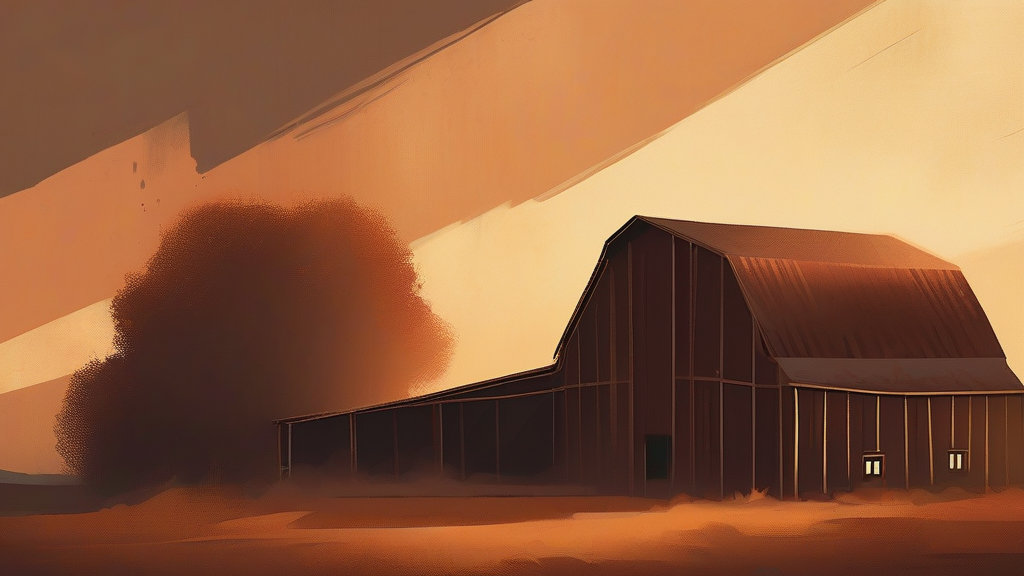
What does barn mean?
A barn is a substantial agricultural outbuilding found on farms, traditionally used to store harvested crops such as hay, straw, and grain, and often to shelter livestock or house farm machinery. The word is common throughout the English-speaking world, though its emphasis differs regionally: American speakers tend to picture the classic timber-framed, often red-painted structure central to rural imagery, while British usage leans toward buildings dedicated to storing corn or hay. Beyond its literal meaning, 'barn' appears in many established phrases — 'barn dance', 'barn owl', 'barn raising', and 'barnstorming' among them — and informally describes any strikingly large interior, as when people call a spacious house 'a barn'. Its associations are overwhelmingly rural and pastoral, evoking self-sufficiency, harvest, and countryside tradition. Simple, ancient, and instantly recognizable, 'barn' remains one of the most enduring words in the vocabulary of farming life.
nounA large farm building used for storing grain, hay, straw, or housing livestock; in British usage it typically refers to a building for storing grain or hay.
- A farm building for storing grain, hay, straw, or farm equipment.
- A building on a farm used to house livestock.
- (Informal) A very large building or spacious interior, as in 'a barn of a house'.
"The old red barn at the edge of the field had sheltered cattle for over a century."
"They stored the harvest in the barn until the wagons could take it to market."
"Their new kitchen was so enormous it felt like a converted barn."
Standard regular plural; used when referring to multiple such buildings.
"Several weathered barns dotted the valley floor."
The phrase 'can't tell a book by its cover' has a barn-flavored cousin: Americans say someone 'couldn't hit the broad side of a barn' — and that broad side can span thousands of square feet.
Reviewed by Deb Chak, Editor. AI-assisted content curated by RJS Tech Solutions LLP.
Etymology of barn
The word 'barn' derives from Old English 'bern', composed of 'bere' meaning barley and 'ærn' meaning a place or building — literally a 'barley-house', reflecting its original purpose of storing grain. It is cognate with related Germanic forms and shares roots with the word 'barley' itself. The term has been in continuous use since the Old English period, making it well over a thousand years old, and its core agricultural meaning has remained remarkably stable across that history.
Related word forms
How barn is actually used
In American English, 'barn' often connotes the iconic red wooden farm structure and carries rustic, nostalgic connotations. In British English it more narrowly suggests grain or hay storage. The informal sense describing any very large room or building ('a barn of a flat') is common in both varieties.
Easily confused with barn
'Barn' is a farm storage building, while 'born' means brought into life — the two sound similar but are entirely unrelated.
'Burn' means to be consumed by fire (and in Scots also a small stream), whereas 'barn' is an agricultural outbuilding.