
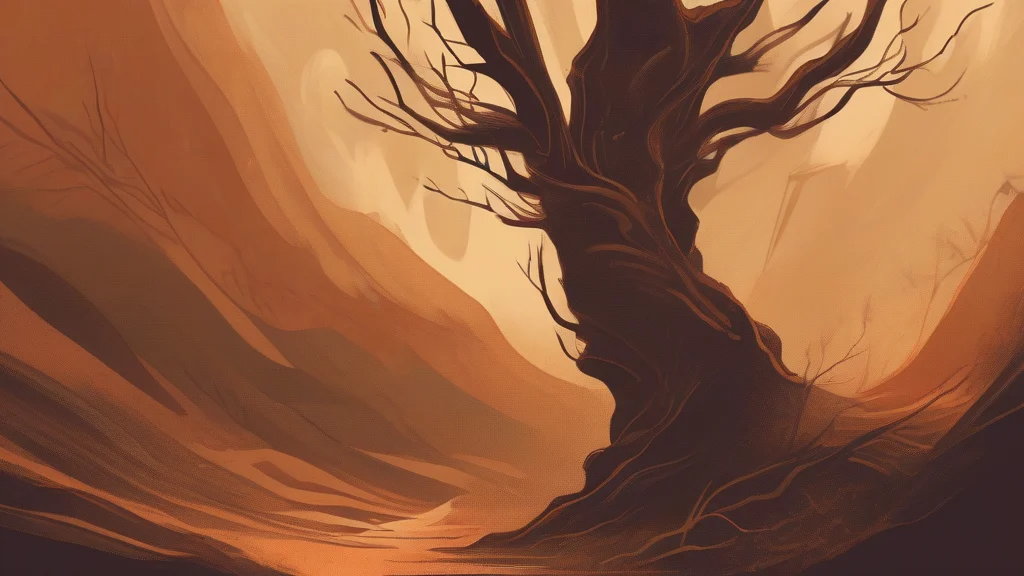
What does gnarred mean?
Gnarred is an adjective and a verb describing something that has become twisted, contorted, or irregular, especially through age, weather, or strain. As an adjective, it commonly evokes weathered tree trunks, branches, hands, or faces. As a verb, it means to twist, knot, or contort, often with a physical or emotional force: a face can gnar with anger. The word is literary and image-driven rather than neutral technical vocabulary, though it is understood in both British and American English. It also suggests permanence and ruggedness: a gnarred branch appears to have endured years of weather. Because “gnarred” is the past form of “gnar,” it can connect an object’s appearance to the action of becoming twisted. Its vividness makes it especially useful in descriptive writing, where it conveys age, texture, hardship, and irregularity more economically than a longer explanation.
Twisted, contorted, knotted, or irregular in form, especially because of age, weathering, or strain.
"A gnarred branch stretched across the garden wall."
The adjective is especially common in literary descriptions of trees, wood, hands, and faces.
To twist, knot, or contort something, or to become twisted, knotted, or contorted.
"He gnarred his hands as the storm battered the cottage."
This use is literary and often describes a face, hands, wood, or another object being physically or emotionally contorted.
Gnarred is how an old tree tells its age without speaking.
Reviewed by Deb Chak, Editor. AI-assisted content curated by RJS Tech Solutions LLP.
Where does gnarred come from?
Gnarred is the regular past tense and past participle of gnar and is also used as a participial adjective. The gnar stem has historical links with Middle English narren and Old English gnarra, whose senses included snarling, chafing, and fretting, before the modern sense of twisting or becoming wrinkled developed. Gnarl, gnarly, and the archaic variant knar belong to the same word family.
How gnarred is actually used
The word is literary and image-driven, especially when describing trees, wood, hands, or faces. It is understood in both British and American English, though the usual British pronunciation lacks the final r.
Easily confused with gnarred
Gnarred is the past tense or participial adjective of gnar and can also function as a verb, whereas gnarly is an adjective that in informal American English can additionally mean difficult or unpleasant.