
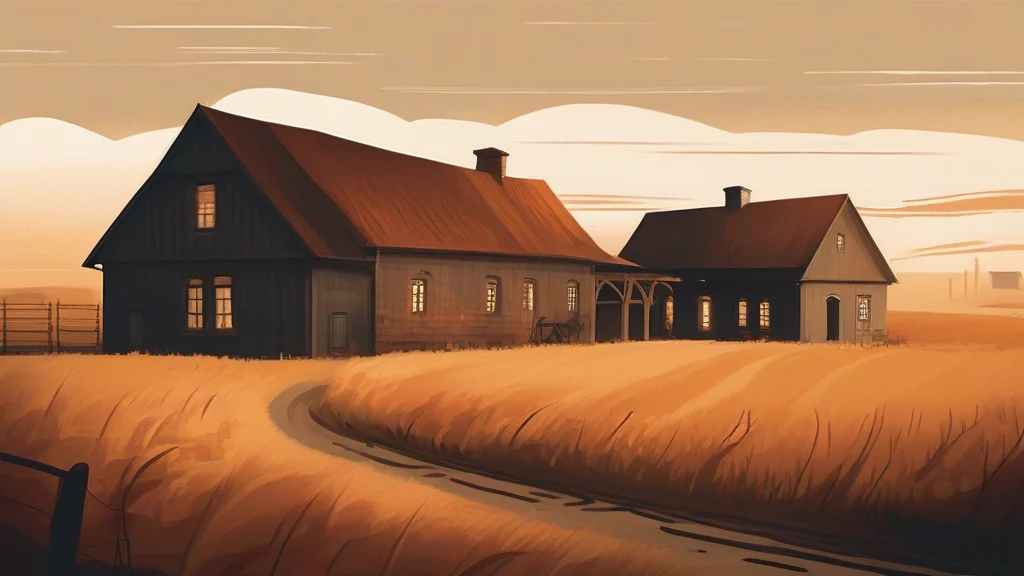
What does grange mean?
A grange is a farm or farmstead, particularly in British English, and the word can also refer more broadly to a rural property or its buildings. In nineteenth- and twentieth-century American history, “the Grange” became the name of an important organization of farmers, the Patrons of Husbandry, which promoted agricultural education and represented farmers' political interests. In American historical contexts, grange may also mean a substantial country house or estate. Older English usage included a farm building used for storage, so the word has a close semantic relationship with granary, although the two are not interchangeable today. Today, grange is uncommon in ordinary conversation but remains useful in discussions of rural history, architecture, agricultural organizations, and the Grange movement. Its associations with farming institutions make it a distinctive word with both architectural and political significance.
nounA grange is a farm or farmstead, especially in British usage; in North American historical contexts, it can also mean a substantial country house or estate. The capitalized “Grange” may also refer to a local branch of the Patrons of Husbandry, an American farmers' organization.
- A farm or farmstead, especially in British English.
- In historical North American usage, a grand country house or estate; in older usage, a farm building or granary.
- A local organization affiliated with the Patrons of Husbandry, especially in the United States, as in “the Grange.”
"The old grange has been restored as a museum and community center."
"After the harvest, visitors arrived at the grange for a celebratory supper."
"The Grange movement helped organize farmers and advocate for their economic and political interests."
The standard plural is granges, used for multiple farms, farmsteads, estates, or organizational branches.
"Several granges across the county hosted open days."
The Grange began as a farmers' organization in 19th-century America and became a force in agrarian politics, showing that even a word about farms can shape national debate.
Reviewed by Deb Chak, Editor. AI-assisted content curated by RJS Tech Solutions LLP.
Where does grange come from?
The English word entered Middle English from Anglo-French grange, a borrowing of Medieval Latin grangia. Medieval Latin grangia is generally traced through Vulgar Latin to Latin granum, meaning grain or seed. Related English words include grain, granary, and granular, all reflecting the same Latin root.
Related word forms
How grange is actually used
The word is somewhat formal, literary, or historical outside institutional references. In British English it commonly denotes a farm or farmstead, while in the United States it is especially associated with the nineteenth-century Grange movement and historic country estates.
Easily confused with grange
A granary is a building used to store grain, whereas a grange generally means the farm or estate itself, although older meanings of the two words overlap.