
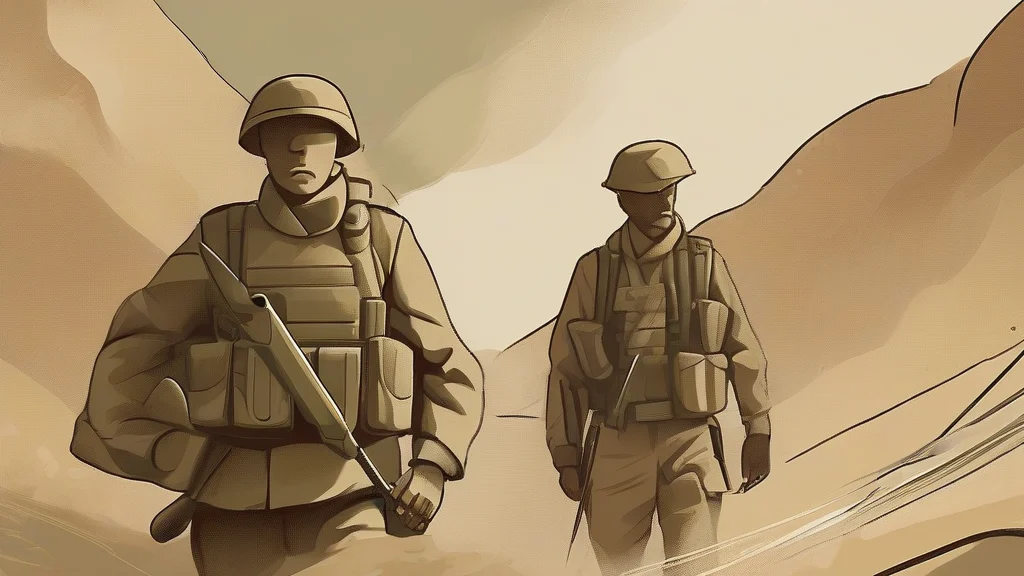
What does khaki mean?
Khaki describes a subdued, dusty-looking brown or greyish-brown colour, and it also names the practical cotton or twill fabric traditionally used for uniforms and outdoor clothing. In phrases such as “khaki shirt,” “khaki trousers,” and “khaki uniform,” it is especially associated with military dress, but it is equally common in workwear, travel clothing, and other garments intended to be durable and unobtrusive. The colour's name entered English from Hindi, where it referred to a dusty shade, and its military association helped make it familiar during the nineteenth century. Today, “khaki” is more often a practical description than a fashionable one, though vintage and military clothing have kept the term in circulation. “Khakis” can also mean a pair of khaki-coloured trousers, especially in American English.
Of a dull yellowish-brown or greyish-brown colour, especially the colour of military uniforms.
"He wore a khaki jacket over a plain white shirt."
Often used for military clothing, workwear, and other practical garments.
A dull yellowish-brown or greyish-brown colour; a sturdy cotton or twill fabric of this colour; or a garment made from such fabric.
"The desert landscape was the colour of khaki."
The word is commonly used in the plural “khakis” for trousers or other garments.
Used for khaki-coloured trousers or other garments, especially in American English.
"He wore blue jeans on Monday and khakis on Tuesday."
The word travelled from India to military history: English borrowed it from Hindi as the name of a dusty brown colour, and khaki uniforms became closely associated with colonial and later military forces.
Reviewed by Deb Chak, Editor. AI-assisted content curated by RJS Tech Solutions LLP.
Where does khaki come from?
The English word comes from Hindi खाकी (khākī), meaning “dusty” or “dust-coloured,” related to खाक (khāk), “dust.” It entered English in the nineteenth century in connection with military uniforms, especially those worn by British troops in India. The same root appears in related forms in Urdu and Punjabi, reflecting the word's South Asian linguistic connections before its adoption into English.
Related word forms
How khaki is actually used
The adjective is standard in British and American English. As a noun, “khaki” is often used in the plural “khakis” for trousers or other clothing; in military contexts it may refer specifically to a uniform of a khaki colour.
Easily confused with khaki
Khaki is a muted brownish or greyish-brown, whereas khaki-green is a distinct greenish shade derived from it.