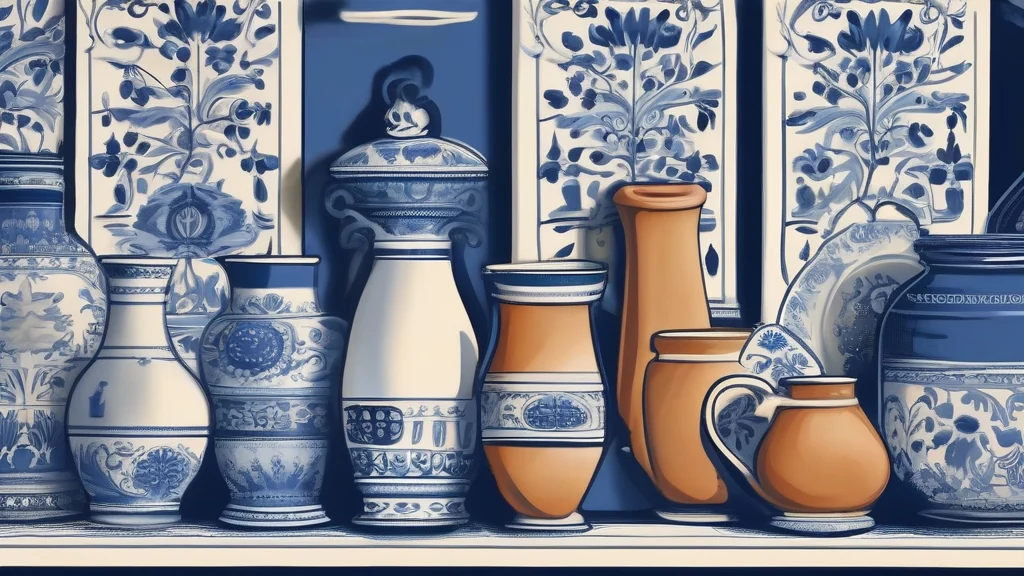
What does delft mean?
Delft is a type of tin-glazed earthenware pottery, characteristically decorated in cobalt blue on a white background, that takes its name from the Dutch city of Delft where it was famously produced from the early seventeenth century onward. Inspired by Chinese porcelain imported by the Dutch East India Company, Delft potters developed a distinctive style that became hugely popular across Europe, adorning plates, vases, jars, and — most iconically — wall tiles. Today the word functions both as a mass noun for the ware itself ('a shelf of delft') and as an adjective describing anything made or decorated in that style ('delft tiles,' 'a delft vase'). It carries connotations of Dutch heritage, traditional craftsmanship, and classic blue-and-white interior design. The related term 'delftware' is often used interchangeably, particularly in museum and collector contexts.
nounA style of tin-glazed earthenware pottery, typically painted in blue on a white ground, originally made in Delft, Netherlands. Also used attributively to describe such pottery or its distinctive blue-and-white style.
- Tin-glazed earthenware pottery with blue decoration on a white ground, first made in Delft, Netherlands.
- A piece of such pottery.
- (attributive) Describing something decorated or styled after such pottery.
"The mantelpiece was lined with delft tiles imported from the Netherlands."
"She displayed a collection of delft on the dresser."
"The kitchen featured antique delft tiles around the fireplace."
Rarely pluralized; 'delft' is usually treated as a mass noun, or 'pieces of delft' / 'delftware' is used instead.
"The cabinet held several delfts from the eighteenth century."
The word for this famous blue-and-white pottery is simply the name of a Dutch city — and that city's name itself means 'dig,' because it grew up along an excavated canal.
Reviewed by Deb Chak, Editor. AI-assisted content curated by RJS Tech Solutions LLP.
Etymology of delft
The word derives from Delft, the name of the Dutch city where the pottery was first manufactured in the early seventeenth century. The city's name comes from the Dutch word 'delf,' meaning a ditch or dug canal, ultimately related to the verb 'delven,' meaning to dig — making it cognate with the English words 'delve' and 'delf.' The term entered English in the seventeenth century as trade in Dutch pottery spread across Europe.
Related word forms
How delft is actually used
Often capitalized as 'Delft' when referring directly to pottery from the city itself; lowercased 'delft' is common when referring to the style generally, though both are widely accepted. The fuller form 'delftware' is frequently preferred in writing to avoid ambiguity.
Easily confused with delft
'Delf' refers to a ditch or drain (especially a mining term or Scottish usage), while 'delft' refers to the Dutch pottery.