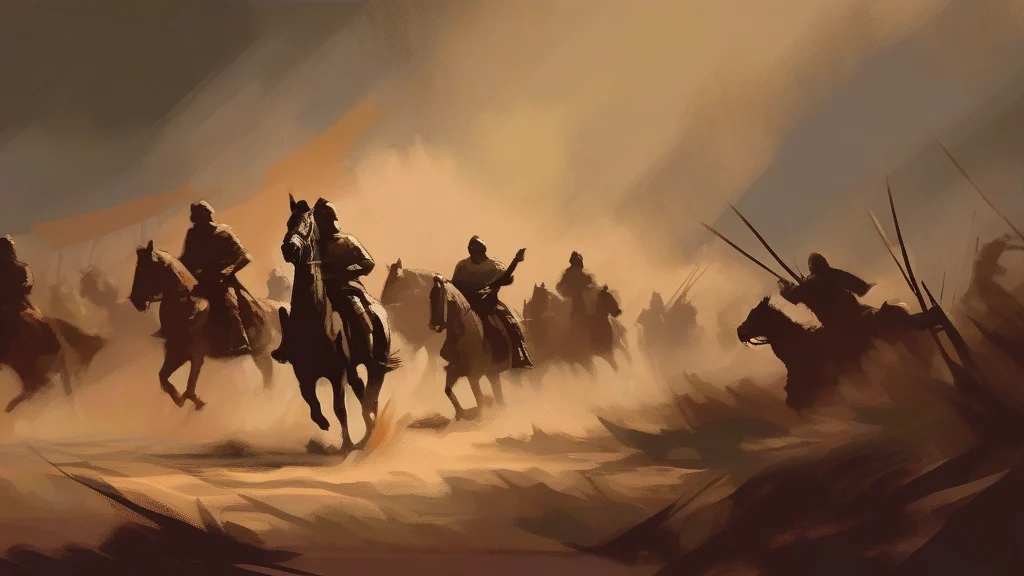
What does cavalrymen mean?
Cavalrymen are soldiers trained to fight on horseback, forming the historic military arm known as cavalry. For thousands of years, cavalrymen provided armies with mobility, shock power in the charge, and speed in reconnaissance and pursuit, and they played decisive roles in battles from antiquity through the nineteenth century — think of the knights of medieval Europe or the charging troopers depicted in paintings of Waterloo. With the advent of machine guns and armored vehicles, horses largely disappeared from warfare, but many modern armies retain cavalry regiments whose members, still called cavalrymen, fight from tanks or other vehicles while preserving old traditions, insignia, and esprit de corps. The word is the plural of 'cavalryman' and is most common in historical writing, military literature, and accounts of ceremonial units. It carries connotations of daring, dash, and romantic martial tradition, and should not be confused in spelling with 'Calvary', the site of the Crucifixion.
nounCavalrymen are soldiers who fight on horseback, or more broadly members of a military unit trained to fight from horseback; the term is the plural of 'cavalryman' and may also apply, in modern armies, to soldiers of mechanized or armored units descended from historical cavalry.
- Soldiers who fight on horseback as part of a military unit.
- By extension, members of a modern armored or mechanized unit that continues the traditions of historical cavalry.
"The cavalrymen charged down the hill at dawn, sabres gleaming."
"Napoleon's cavalrymen swept across the battlefield, breaking the enemy's left flank."
"Though tanks had replaced horses, the regiment's cavalrymen still wore their traditional crossed-sabre insignia with pride."
'Cavalrymen' is already the plural form, being the plural of 'cavalryman'. The singular is 'cavalryman'; note that the mass noun 'cavalry' takes its own singular sense referring to the branch as a whole.
"A hundred weary cavalrymen dismounted beside the river at dusk."
Every time someone misspells 'cavalry', they're actually writing 'Calvary' — the hill where Christ was crucified — one of the most common typos in English.
Reviewed by Deb Chak, Editor. AI-assisted content curated by RJS Tech Solutions LLP.
Etymology of cavalrymen
The word derives from 'cavalry', which entered English in the late sixteenth century from French 'cavalerie', ultimately rooted in the Late Latin 'caballarius', meaning 'horseman', from 'caballus', Latin for horse. The agent noun 'cavalryman', formed by adding '-man' to denote an individual soldier, arose as cavalry became established as a distinct arm of European armies. The same Latin root gave English several related words, including 'cavalier', 'chevalier', and 'chivalry', all conveying the idea of a mounted warrior.
Related word forms
How cavalrymen is actually used
'Cavalrymen' is the standard plural of 'cavalryman'; the collective noun 'cavalry' is often used instead when referring to the force as a whole rather than individual soldiers. The word carries historical and somewhat formal or literary connotations, appearing most often in military history, fiction set before the twentieth century, and descriptions of ceremonial units.
Easily confused with cavalrymen
'Cavalry' is the collective branch or body of mounted troops, while 'cavalrymen' refers to the individual soldiers within it.
'Calvary' is the hill outside Jerusalem where Jesus was crucified and is often confused in spelling with 'cavalry', which concerns mounted soldiers.