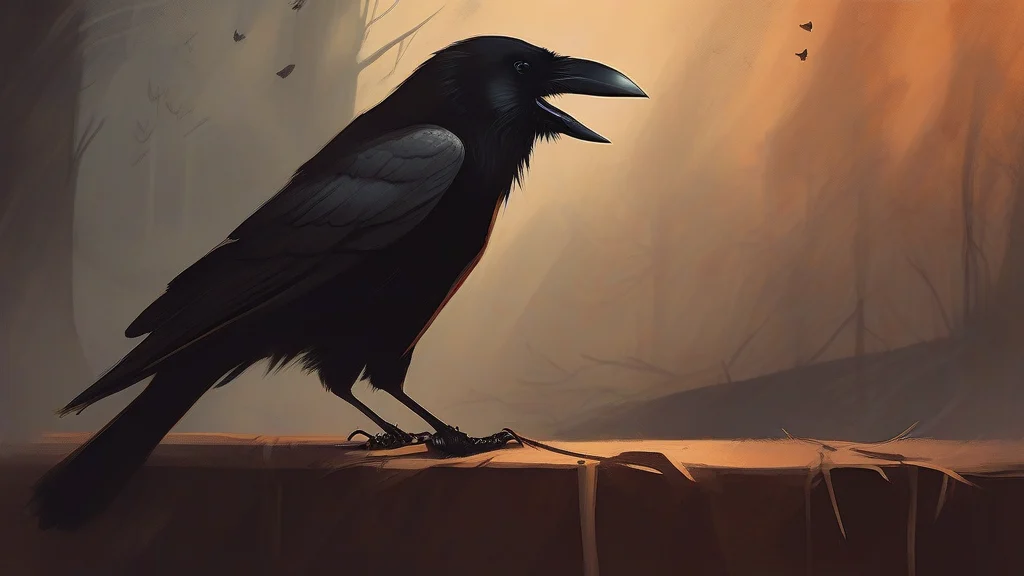
What does cawing mean?
Cawing refers to the loud, rough, hoarse cry made by crows, ravens, and other members of the corvid family, as well as to the act of uttering such a sound. As a noun it names the noise itself — 'the cawing of crows filled the evening air' — while as a verb it describes the bird's action, as in 'a raven sat cawing on the fence post'. The word is imitative in origin, coined simply by echoing the sound it describes, and it entered English around the early seventeenth century alongside the verb 'caw'. In tone, cawing is neutral and descriptive in ordinary use, but writers often deploy it for atmosphere: the harsh, grating quality of the cry lends itself to scenes of desolation, winter landscapes, or quiet unease. Because no other English word captures this particular sound so precisely, cawing remains the standard and most vivid choice whenever corvid voices need describing.
The harsh, hoarse cry of a crow, raven, or similar bird.
"We woke to the incessant cawing of crows roosting in the elms."
Usually used with a definite article and often followed by 'of' plus the bird's name.
Present participle of 'caw': to make a harsh, hoarse cry like that of a crow.
"A lone crow sat on the telegraph wire, cawing at passers-by."
Crows can recognize individual human faces — so the cawing outside your window might genuinely be about you.
Reviewed by Deb Chak, Editor. AI-assisted content curated by RJS Tech Solutions LLP.
Etymology of cawing
Cawing derives from the verb 'caw', an imitative or echoic formation that reproduces the actual sound of a crow's cry rather than descending from an older root. The verb appeared in English in the early seventeenth century, with the noun and participle forms developing directly from it. Being onomatopoeic, it has no classical cognates; similar echoic words exist independently across languages wherever crows are heard.
Related word forms
How cawing is actually used
Register is neutral; the word appears in both everyday description and literary prose. It carries mildly ominous or eerie connotations in literature because of the traditional association of crows and ravens with gloom or ill omen, though it is often used purely descriptively of birdsong.
Easily confused with cawing
A craw is the crop or stomach of a bird (as in 'sticks in my craw'), while cawing is the harsh cry a crow makes.