What does corn mean?
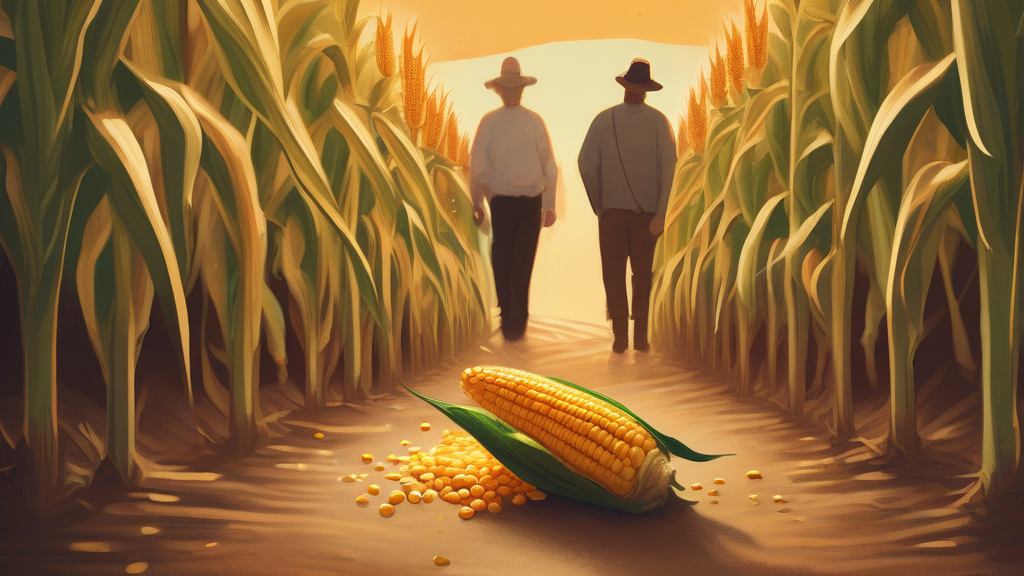
Corn is one of those deceptively simple words whose meaning depends heavily on where you stand. In American English it denotes maize — Zea mays — a tall cereal grass native to the Americas, grown worldwide for its sweet yellow kernels and processed into everything from tortillas to corn syrup and livestock feed. Elsewhere in the English-speaking world, 'corn' has historically meant whatever grain was the local staple: wheat in England, oats in Scotland and Ireland, rye in parts of northern Europe. The word can also refer to an individual grain or seed, and to the small, painful patch of hardened skin that forms on a toe under pressure. Its derivatives are equally familiar — 'corny' for something trite and sentimental, 'corned beef' for meat preserved with coarse grains of salt. Few everyday words carry so much agricultural history, colonial exchange, and regional identity packed into a single syllable.
A cereal plant and its edible grain; in American English specifically maize, and in British English generally the chief cereal crop of a region.
"The Midwest produces vast quantities of corn each year."
Specify 'maize' when writing for an international audience to avoid ambiguity.
A small callus of thickened, hardened skin on the foot, usually formed by friction or pressure.
"Her new shoes gave her a painful corn on her little toe."
A single seed or kernel of a cereal grain.
"He picked a corn of wheat from the sack and examined it."
As a mass noun for the grain itself, corn is normally uncountable ('a bushel of corn'). The plural 'corns' is used mainly for individual kernels or for the skin growths on the feet.
"The long walk left corns on both of her heels."
When the Pilgrims wrote about 'Indian corn,' they were describing what most of the world still calls maize — because 'corn' simply meant whatever grain was dominant where you lived.
Reviewed by Deb Chak, Editor. AI-assisted content curated by RJS Tech Solutions LLP.
Etymology of corn
Corn comes from Old English 'corn,' which originally meant a small, hard particle — especially a single grain of a cereal — and is closely related to Dutch 'koren' and German 'Korn.' The underlying Proto-Germanic root connects it to Latin 'granum' (grain), making words like 'grain,' 'granary,' and 'pomegranate' distant cousins. When English settlers reached the Americas, they applied their general term for the staple grain to maize, fixing that narrower sense in North America. The foot condition takes its name from the same old idea of a small, hard kernel-like growth, while 'corny' arose in early twentieth-century America from associations with rural corn-growing regions and their perceived unsophisticated humor.
Related word forms
How corn is actually used
The single biggest trap with this word is regional: in North America 'corn' almost always means maize, while in British, Irish, Australian, and New Zealand English it traditionally refers to whichever cereal grain dominates locally (usually wheat in England, oats in Scotland and Ireland). In formal or international writing, 'maize' is unambiguous. The foot condition called a corn is unrelated in origin as a modern sense but shares the same word, originally referring to something small and hard like a grain.
Easily confused with corn
A corm is a short, swollen underground plant stem (as in crocuses and gladioli), whereas corn is a cereal grain — the two differ by only one letter.